Neutral cure silicone is the right RTV for electronics because it cures without releasing acetic acid, the vinegar-smelling byproduct of standard acetoxy silicone that can attack sensitive metals in a confined space. ASI 388 Electronic Grade RTV is a one-part, oxime neutral-cure silicone made for sealing, insulating and encapsulating electronic parts. It is UL Recognized, meets MIL 46106B Type 1, and has a dielectric strength of 500 volts per mil on ASI’s technical data sheet.
What “electronic grade” means for ASI 388
“Electronic grade” is not a single industry standard, so look at the data sheet instead of the label. For ASI 388 the data sheet gives you the numbers that matter around circuits:
| Property (ASI 388 TDS) | Value | Why it matters |
|---|---|---|
| Cure chemistry | One-part, moisture-cure, neutral (oxime) | No acetic acid released while curing |
| Dielectric strength (ASTM D149) | 500 V/mil | Insulates between conductors |
| Volume resistivity (ASTM D257) | 3 x 10^15 | Cured rubber does not conduct |
| Service temperature | -70°F to 400°F; intermittent to 450°F | Handles hot components and cold enclosures |
| Skin time / cure | 20 minutes / 24 hours per 1/8″ bead (70°F, 50% RH) | Working time and when you can handle it |
| Hardness / elongation | 30 Shore A / 600% | Soft and stretchy, so it relieves stress on parts |
| Listings | UL Recognized (File E209770); MIL 46106B Type 1 | Documented for electrical use |
ASI also lists a dielectric constant of 3 and a dissipation factor of 5 x 10^-3 at 50 Hz, and VOC content of 21 g/L. ASI notes that 388 keeps consistent electrical properties through changes in temperature and humidity, which is what makes it a usable insulator for electronic components.
Is RTV silicone conductive?
No. Cured RTV silicone is an electrical insulator, which is why it is used to pot and seal electronics. ASI 388’s 500 V/mil dielectric strength and 3 x 10^15 volume resistivity put numbers on that. Specialty conductive silicones do exist, but they are made with conductive fillers and are sold and labeled as conductive.
Acetoxy vs neutral cure in one paragraph
ASI makes both chemistries. Acetoxy silicones such as ASI 502 skin faster, bond well to glass, metal and tile, and some grades are food-contact rated, but they release acetic acid while curing, and ASI’s own comparison chart flags them as corrosive to sensitive metals when confined. Neutral cure silicones such as ASI 388 have low odor, a broader adhesion range and are non-corrosive to most metals, but they are not food grade. For the full comparison, see our guide to acetoxy vs neutral cure silicone.
Where ASI 388 is used
- Sealing lead wire entries into housings and junction boxes
- Waterproofing electronics and sealing electronic assemblies
- Circuit board protection and covering sensitive components
- Electronic encapsulating and component mounting (holding capacitors, coils and wires against vibration)
- Electrical connections and telecom work, including coaxial cable connectors
- Engine components and general industrial sealing
ASI lists glass, most metals, aluminum, steel, most fiberglass, vinyl, PVC, rubber, natural and synthetic fiber, most painted surfaces and some plastics as common substrates, and asks users to test every substrate first.
The copper caution
Neutral cure does not mean “safe on everything.” ASI’s data sheet states that ASI 388 can discolor copper around the applied area or in a confined area. In practice: test on a scrap board first, keep beads off exposed copper bus bars and bare traces where appearance or long-term contact matters, and let the part cure with the enclosure open so curing vapors can escape. If a board has a conformal coating or solder mask over the copper, test on that surface too.
How to apply ASI 388 to electronics
- Power down and disconnect the device. Make sure surfaces are clean, dry and free of flux residue, oil and dust; ASI says to use it only on clean surfaces free of contaminants.
- Mask anything that must stay serviceable: connector contacts, switches, potentiometers, test points and heat sink faces.
- Apply between -35°F and 150°F. Lay a bead or dab where it is needed rather than flooding the board.
- Tool or shape it within about 20 minutes, before the skin forms.
- Let it cure: about 24 hours per 1/8-inch bead at 70°F and 50% relative humidity. Cold and dry air slow the cure, and deep sections take longer because moisture cures the silicone from the surface inward.
- Wait for full strength before stress testing. ASI says strength keeps building for 7 days and recommends testing adhesion on day 7.
Safety
ASI 388 releases methyl ethyl ketoxime (MEKO) while curing. Its safety data sheet carries warnings that it causes serious eye irritation, may cause an allergic skin reaction and is suspected of damaging fertility. Work with ventilation, wear gloves and eye protection, and read the label and SDS before use. Both SDS and TDS are on our technical documents page.
Which size to buy
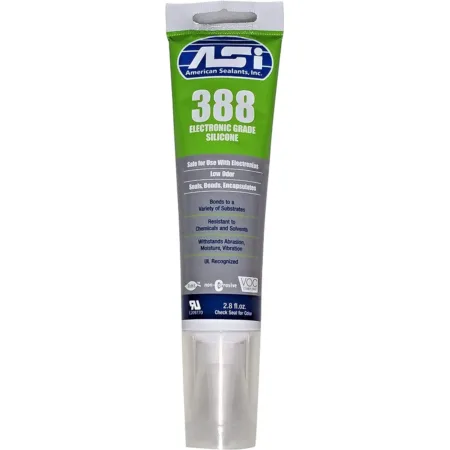
- ASI 388 Electronic Grade RTV, 2.8 oz squeeze tube for repairs, prototypes and bench work, where you want to use a small amount at a time.
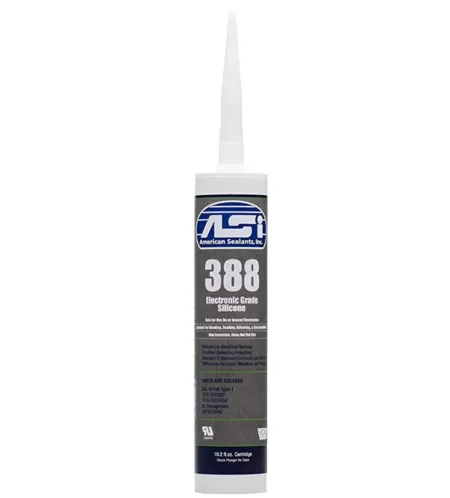
- ASI 388 Electronic Grade RTV, 10.2 oz cartridge for a standard caulking gun, production sealing and larger enclosures.
ASI rates 388 for 12 months of shelf life from shipment when stored at 70°F and 50% RH, so buy the size you will use within a year. Both are clear. Compare all ASI sealants on our sealants and silicones page.
Frequently asked questions
What is electronic grade silicone?
A silicone formulated and tested for use around electronics. For ASI 388 that means a neutral oxime cure, 500 V/mil dielectric strength, UL Recognition and MIL 46106B Type 1.
Is ASI 388 safe on copper?
Test first. ASI states that 388 can discolor copper around the applied area or in a confined area.
Can I use regular bathroom silicone on a circuit board?
Many general-purpose silicones are acetoxy cure (check the label, or notice a vinegar smell) and release acetic acid while curing, which can corrode sensitive metals in a confined space. Use a neutral cure electronic grade silicone instead.
How long before I can power the device?
ASI gives 24 hours per 1/8-inch bead at 70°F and 50% RH, with strength building for 7 days. As a practical minimum, allow that 24-hour cure before you close the enclosure and power the device.
Bottom line
For electronics, choose a neutral cure, electronic grade RTV such as ASI 388: it insulates, stays flexible from -70°F to 400°F and does not release acetic acid. Test on copper, cure it with the enclosure open, and wait 7 days for full strength. New to RTV terms? Read what RTV silicone means.
Products in this guide
-
ASI
ASI 388 Electronic Grade RTV Silicone, Clear, 2.8 oz Squeeze Tube
Original price was: $13.90.$11.30Current price is: $11.30.Out of stock
- Dielectric
-
ASI
ASI 388 Electronic Grade RTV Silicone, Clear, 10.2 oz Cartridge
Original price was: $24.99.$21.90Current price is: $21.90.Out of stock
- Dielectric