
For a camp stove, butane is the compact, tidy choice for mild weather, and propane is the choice when it gets cold or you need a bigger stove. The deciding fact is the boiling point: butane boils at about 32°F (0°C) and propane at about -44°F (-42°C), so a butane canister loses pressure near freezing while propane keeps vaporizing well below zero. Per pound, the two fuels carry almost the same energy.
Products in this guide
Butane vs propane at a glance
| Factor | Butane | Propane |
|---|---|---|
| Boiling point (NIST) | About 32°F (0°C) | About -44°F (-42°C) |
| Energy per pound (higher heating value) | About 21,100 BTU | About 21,600 BTU |
| Typical container | Slim 8 oz canister with a notched collar | 1 lb disposable cylinder or refillable tank |
| Storage pressure | Low, so the can is light | High, so cylinders are heavier steel |
| Cold weather | Weakens near and below freezing | Works well below freezing |
| Typical stove | Single-burner tabletop stove | Two-burner camp stove, larger burners |
Why temperature decides most of it
A canister stove burns vapor, not liquid. Fuel has to boil inside the container to make that vapor, and it can only do that when the container is warmer than the fuel’s boiling point. NIST lists the normal boiling point of butane at about 273 K, which is roughly 32°F, and propane at about 231 K, roughly -44°F.
In practice that means a butane can on a 70°F afternoon has plenty of pressure, but on a 35°F morning it has very little, and the flame shrinks. Drawing vapor also cools the can, so a butane stove can fade during a long simmer even in mild weather. Propane, with a boiling point far below anything you will camp in, keeps producing vapor on a cold morning.
Backpacking stoves often use a third option: screw-on canisters filled with an isobutane blend. Isobutane boils at about 12°F (-11°C) according to NIST, so those canisters handle cool weather better than straight butane. They use a threaded valve and do not fit stoves built for the 8 oz notched butane can, or the other way around.
Energy and runtime: closer than most people think
Engineering reference tables put butane at about 21,100 BTU per pound and propane at about 21,600 BTU per pound (higher heating values). Pound for pound, the difference is under 3%. What changes runtime is the size of the container and the stove’s burn rate. An 8 oz butane can holds about half a pound of fuel, roughly 10,000 BTU, which is a little more than an hour at full flame on a 9,000 BTU stove. Our guide to how long an 8 oz butane canister lasts walks through the math.
When butane is the better pick
- Mild-weather camping, tailgates and picnics. A single-burner butane stove is compact, sets up in seconds and has no hose to connect.
- Packing light in a car. Slim cans stack neatly in a crate, and the stove fits in a backpack-size case.
- Emergency kits. A butane stove and a pack of cans store easily in a closet. Rotate the cans and keep them below 120°F (49°C).
- Catering stations and outdoor food service where a low-profile burner fits on a table.
When propane is the better pick
- Cold weather. As the temperature drops toward freezing, a butane stove loses power, and near 32°F it may barely run. Propane does not have that problem.
- Two-burner cooking for a group. Many two-burner camp stoves are built for propane.
- Long cooking sessions where you do not want to swap cans mid-meal; a refillable tank holds far more fuel.
If you want both options, some stoves accept either fuel. Gas One, for example, sells dual-fuel stoves alongside its butane-only and isobutane models. Follow your stove’s manual for each connection, and never use an adapter the manufacturer does not approve.
Can you use a butane or propane stove indoors?
Treat both the same way: follow the label, and never run either one in a tent, camper, vehicle or other enclosed space. The U.S. Consumer Product Safety Commission notes that people die every year from carbon monoxide poisoning caused by portable camping heaters, lanterns and stoves used inside tents, campers and vehicles. Many portable stoves are labeled for outdoor use only. If your stove’s manual does allow indoor use, use it only with real ventilation and a working carbon monoxide alarm, and keep the canister compartment uncovered so it cannot overheat.
Know the warning signs of carbon monoxide exposure that CPSC lists: headache, dizziness, weakness, nausea, vomiting, sleepiness and confusion. Turn the stove off and get to fresh air if anyone feels them.
Storage and handling for both fuels
- Store containers upright, away from heat, flames and direct sun. Gas One warns against storing butane where temperatures exceed 120°F (49°C).
- Connect and disconnect containers outdoors, away from any flame.
- Never put a used canister or cylinder in a fire. Ask your local waste program how to dispose of empties.
- Do not refill containers sold as non-refillable. The GasOne GAS-1 butane canister is non-refillable.
What we carry
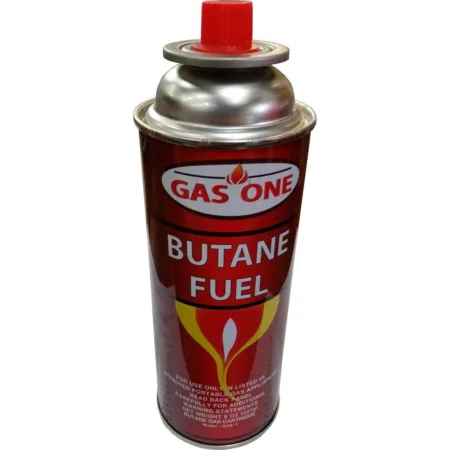
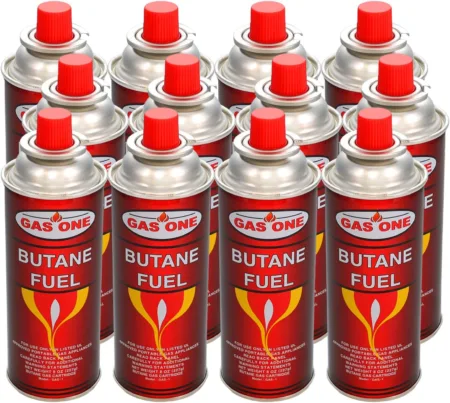
We stock GasOne 8 oz butane canisters for stoves that take the notched-collar can: a single GasOne 8 oz butane canister to top up a kit, and a GasOne 8 oz butane 12-pack for regular campers, emergency kits and food-service stations. Four- and eight-packs and a 24-pack case are on our portable fuels page. We do not sell propane cylinders. We ship GasOne butane by ground to New Jersey, New York and Florida only. The packs ship free to NJ and NY, and any order of $35 or more ships free.
Frequently asked questions
Is butane or propane better for a camp stove?
Butane is more compact and convenient in mild weather; propane is the better choice in cold weather or for larger two-burner stoves.
Does butane work in cold weather?
Poorly near freezing. Butane boils at about 32°F (0°C), so a cold can produces little vapor and a weak flame.
Which fuel burns hotter or lasts longer?
Per pound they carry nearly the same energy. Runtime depends on how much fuel the container holds and how hard the stove burns it.
Can I use a butane stove in my tent?
No. Fuel-burning stoves inside tents, campers and vehicles are a known cause of carbon monoxide deaths, according to CPSC.
Bottom line
Choose butane for compact, mild-weather cooking and propane for cold mornings and bigger stoves. The energy per pound is nearly identical, so the real differences are temperature, container size and stove type. Whichever you use, cook outside and store fuel cool. Serving food indoors instead? See our chafing fuel guide.
Before you cook indoors or on a balcony, read the indoor-use rules in New York City and New Jersey, and compare GasOne butane canisters by pack size.
Products in this guide
-
Gas One
GasOne Butane Fuel Canister, 8 oz
$6.99In stock — ships in 1–3 days
- Ships to NJ/NY/FL only
- Ground ship only
-
Gas One
GasOne Butane Fuel Canisters, 8 oz (Pack of 12)
$25.99$2.17 / can
In stock — ships in 1–3 days
- Free ship NJ/NY
- Ships to NJ/NY/FL only
Sources
- NIST Chemistry WebBook: Butane, phase change data
- NIST Chemistry WebBook: Propane, phase change data
- NIST Chemistry WebBook: Isobutane, phase change data
- The Engineering ToolBox: Fuels, higher and lower calorific values
- U.S. CPSC: Portable heaters and camping equipment (carbon monoxide)
- Gas One: GS-3000 portable butane stove (product page and stove categories)
- Gas One: GS-3000 owner’s manual