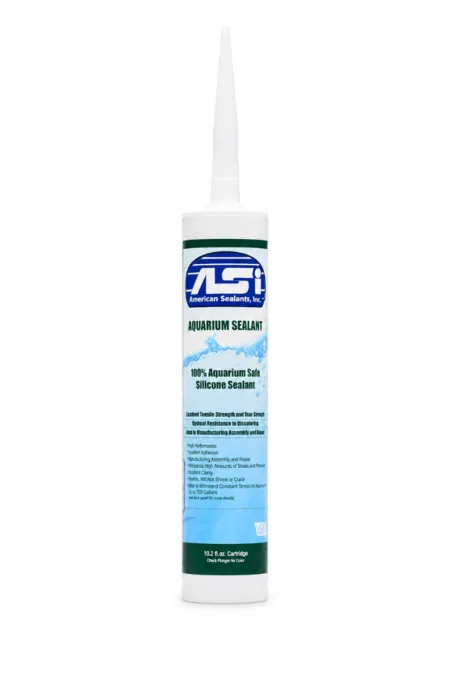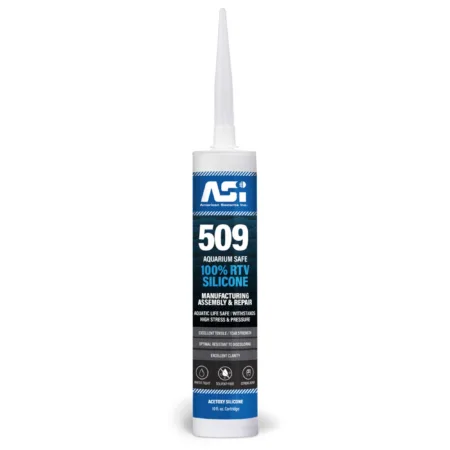
ASI 509 Aquarium Silicone Sealant forms a skin in about 10 minutes and cures a 1/8-inch bead in about 24 hours at 70°F and 50% relative humidity, but ASI recommends waiting for full cure, 7 days, before using the aquarium. In practice that means no water and no fish until day 7. Thick or enclosed beads, cold air and dry air all stretch the timeline.
The ASI 509 cure timeline
| Time after application | What’s happening | What to do |
|---|---|---|
| First 10 minutes | Working time before a skin forms (at 70°F and 50% RH) | Tool the bead now; ASI says tooling should be done before skinning |
| About 24 hours | Typical cure for a 1/8-inch bead | Leave it alone; don’t stress the joints or move the tank |
| Days 1 to 7 | Strength keeps increasing for 7 days after application | Keep the room ventilated; the tank stays empty and dry |
| Day 7 | Full cure; ASI recommends testing strength and adhesion on the 7th day | Begin using the aquarium, starting with a water-only leak check |
What slows the cure
- Cold, dry air. ASI says cold temperatures and low humidity slow skin and cure time, while higher temperature and higher humidity speed them up. Its suggested application range is -35°F to 150°F.
- Confinement. Where sealant is partly or fully enclosed, such as between overlapping panes, ASI says the time needed for proper cure lengthens with the degree of confinement.
- Bead size. The 24-hour figure is for a 1/8-inch bead. Larger beads need longer to cure through.
- Dirty or oily surfaces. ASI says to use the sealant only on clean surfaces free of contaminants.
How to get a clean, full cure
- When resealing, remove the old sealant from the joint completely. ASI says cured sealant can be removed by abrading or scraping, with help from its ASI 0240 remover.
- Clean and dry the glass. ASI recommends 100% isopropyl alcohol or acetone, depending on the substrate, and says not to use petroleum-based solvents.
- Work in a well-ventilated room near 70°F. ASI’s safety data sheet notes an acetic acid (vinegar) odor during cure and says to use the product only outdoors or in a well-ventilated area.
- Run a continuous bead and tool it within the first 10 minutes, before it skins. ASI 509 is non-slump, so vertical and overhead seams hold their shape.
- Leave the tank empty, dry and undisturbed for 7 days.
- On day 7, we suggest filling with water alone and checking every seam before adding fish, plants or decor.
Can you speed it up?
Only a little, and only through conditions. ASI says higher temperature and higher humidity accelerate skin and cure time, so a warm room with normal humidity cures faster than a cold, dry garage. What doesn’t work is adding water early. ASI’s guidance is to wait for full cure, 7 days, before using the aquarium, and its product literature lists “must cure before water contact” as a basic trait of silicone sealants.
Surfaces, storage and shelf life
ASI lists glass (with primerless adhesion), most acrylics, aluminum and other metals, steel, porcelain, PVC, most types of wood and some plastics as bonding substrates, and asks you to test your own material first. It says not to use ASI 509 on porous surfaces such as concrete, mortar or brick, and notes that it can’t be painted. That matters if you’re building a terrarium or vivarium with a background: plan the silicone work before any finishing.
Storage affects the cartridge before it ever reaches the tank. ASI rates a 12-month shelf life from the date of shipment when stored at 70°F and 50% relative humidity, warns that high temperature and humidity can significantly shorten it, and says not to store the sealant at elevated temperatures. Keep spare cartridges indoors, not in a hot garage or car.
Clear or black ASI 509?
Both colors are the same ASI 509 formula in a 10.2 oz caulking cartridge with the same published properties: 45 Shore A hardness, 520 psi tensile strength, 500% elongation and a -50°F to 400°F service range. Both are made for saltwater and freshwater tanks and bond to glass without a primer. Choose ASI 509 aquarium silicone in clear when you want low-profile glass seams, or ASI 509 aquarium silicone in black for a defined, framed look.
Frequently asked questions
Can I use regular silicone in an aquarium?
Use a sealant its manufacturer labels for aquariums. ASI makes 509 specifically for aquarium manufacturing and repair and describes it as aquatic-life safe once cured; general-purpose sealants aren’t labeled that way.
Does ASI 509 work on acrylic tanks?
ASI lists “most acrylics” among its bonding substrates and asks you to test your specific material first. Allow 7 days for maximum adhesion before judging a test bead.
Is the cure time the same for clear and black?
Yes. Both colors share the same ASI 509 data sheet: about 10 minutes to skin, about 24 hours for a 1/8-inch bead, and 7 days to full cure before the aquarium is used.
How well does it hold up underwater?
In ASI’s water immersion study (ASTM C-961), lap shear strength was 212 psi after 1 day and 203 psi after 300 days in water, with cohesive failure each time.
Bottom line
Expect a skin in 10 minutes, a cured 1/8-inch bead in about a day and full cure in 7 days, and keep water and fish out of the tank until day 7. Warmth and normal humidity help; cold, dry air and thick, enclosed beads slow things down. Shop sealants and silicones or the full ASI line, read what RTV silicone means and acetoxy vs neutral cure silicone, and download the ASI 509 TDS and SDS from our technical documents page.
Sources
- American Sealants Inc. (Meridian Adhesives Group), ASI 509 Aquarium Sealant technical data sheet: PDF
- Meridian Adhesives Group, ASI 509 Aquarium Sealant product page: meridianadhesives.com
- American Sealants Inc., ASI Aquarium Clear safety data sheet: PDF
- American Sealants Inc., product brochure (archived January 2025): PDF
Products in this guide
-
ASI
ASI 509 Aquarium Silicone Sealant, Clear, 10.2 oz Cartridge
$19.99In stock — ships in 1–3 days
- Aquarium safe
-
ASI
ASI 509 Aquarium Silicone Sealant, Black, 10.2 oz Cartridge
Original price was: $23.30.$19.99Current price is: $19.99.In stock — ships in 1–3 days
- Aquarium safe