If you’re shopping for food grade grease for a KitchenAid mixer or another stand mixer, look for a grease that is NSF H1 registered, which means it is acceptable where incidental food contact can happen. KitchenAid says its mixers leave the factory packed with enough food-grade grease to last the life of the mixer, so most owners never add any. If you do repack a gearbox, remove all the old grease first and use an H1 grease such as Super Lube Multi-Purpose Synthetic Grease (NSF Reg. #096790).
FACTOVAL is not affiliated with KitchenAid. Brand names are used only to identify the equipment this guide applies to.
Does your mixer actually need new grease?
Often it doesn’t. KitchenAid’s support page on oil leaking from a stand mixer explains that some oil can separate out of the solid grease and settle at the lowest point of the motor head. That is more likely in warm weather, when the mixer isn’t used often, or when it is overused without cooling between batches. KitchenAid says it isn’t necessary to add oil as part of regular maintenance.
KitchenAid also says that once a mixer starts to leak oil, the only way to stop it completely is service: a servicer takes out all the old grease, repacks with new grease and replaces the gasket. That gives you a sensible rule:
- A little oil after long storage: wipe it up and use the mixer. No regrease needed.
- A leak that keeps coming back: the gearbox needs a full repack and a new gasket, by a servicer or by you.
- Gearbox already open for a gear repair: repack while you’re in there.
If your mixer is under warranty, contact the manufacturer before opening it yourself.
What “food grade” means for mixer grease
In practice, “food grade” means NSF H1. NSF’s registration certificates describe H1 as a lubricant acceptable for incidental food contact in and around food processing areas, used in the minimum amount needed to do the job. KitchenAid describes its own mixer grease the same way: food grade and approved for incidental contact with the food prepared in the mixer. H1 does not mean edible. It means the formula meets the FDA rule for lubricants that may touch food incidentally, used in the smallest amount that works. Look for the NSF mark and the H1 category code on the label.
What to look for in a stand mixer grease
| What to look for | Why it matters | Super Lube Multi-Purpose Synthetic Grease |
|---|---|---|
| NSF H1 registration | Some grease can migrate toward the beater shaft | NSF H1, Reg. #096790 |
| A true grease, not an oil | Stays on the gear teeth | NLGI grade 2; NLGI GC-LB approved in grade 2 |
| Low oil separation | Separated oil is what leaks out | Under 2% (ASTM D6184), per the data sheet |
| Temperature range | Gearboxes warm up under heavy dough | -45°F to 450°F (-43°C to 232°C) |
| Clean appearance | Easy to see and wipe residue | Translucent white |
Super Lube’s data sheet also notes there is no silicone in this grease, and lists it as compatible with most other greases. Its directions still recommend purging other greases before use, which matches KitchenAid’s servicer practice of removing all the old grease.
Regreasing: the outline
Disassembly differs between tilt-head and bowl-lift models and between generations, so follow a service guide written for your model number. The grease side of the job looks like this:
- Unplug the mixer, remove the bowl and attachments, and work on a covered bench.
- Open the gear housing as your model’s service guide describes.
- Remove all the old grease from the gears and housing. Don’t mix old and new.
- Inspect the gears. Chipped or badly worn gears need replacement; new grease won’t quiet a broken tooth.
- Pack fresh H1 grease onto the gears and into the housing, replacing roughly the amount you removed. KitchenAid’s support page doesn’t publish a fill quantity.
- Fit a new gasket, which KitchenAid’s servicers replace as part of the job.
- Reassemble, run the mixer empty for a minute, and wipe any grease from around the beater shaft before the first batch.
Which size to buy
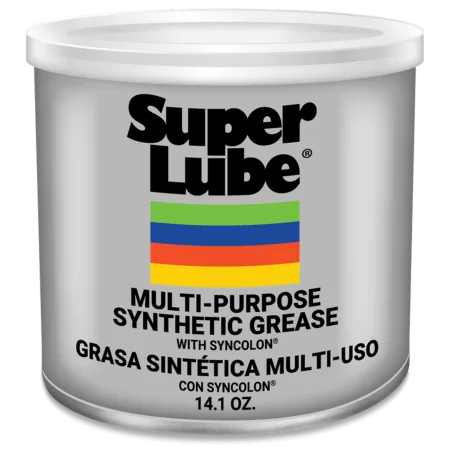
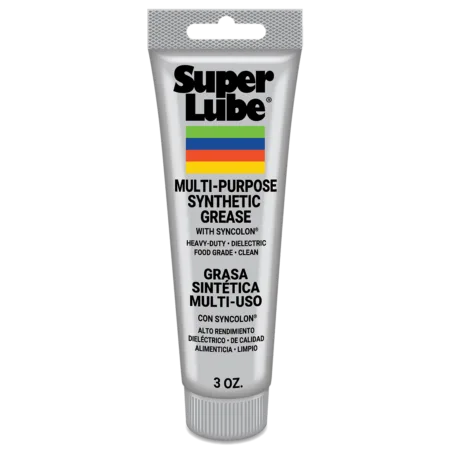
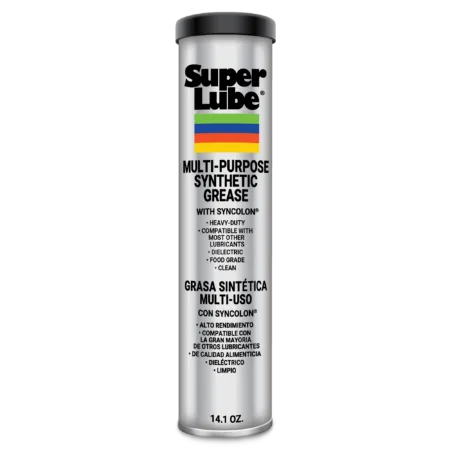
The same Super Lube formula comes in several packages. The Super Lube 41160 14.1 oz canister suits a full gearbox repack because you can scoop from it, with plenty left for other kitchen and shop equipment. The Super Lube 21030 3 oz tube is the tidy choice for small jobs and touch-ups. If you service mixers or other equipment with a grease gun, the 41150 14.1 oz cartridge is the grease-gun format. For more on the formula itself, see what Super Lube grease is.
Frequently asked questions
Can I use automotive wheel-bearing grease in a stand mixer?
We don’t recommend it. Unless the label shows NSF H1 registration, a grease isn’t intended for incidental food contact, and mixer grease can reach the area around the beater shaft.
Is food grade grease safe to eat?
No. H1 means acceptable for incidental contact in the smallest amount that does the job, not an ingredient. Wipe away any grease you see near food.
Will regreasing stop my mixer’s oil leak?
KitchenAid’s fix for a persistent leak is to remove all old grease, repack and replace the gasket. Fresh grease alone, without a new gasket, may not stop it.
Bottom line
A few drops of separated oil are normal and don’t call for new grease. When a stand mixer gearbox does need repacking, clean out every bit of the old grease, use an NSF H1 grease, fit a new gasket and follow your model’s service guide. Shop all food grade greases and NSF H1 lubricants, and find the Super Lube data sheet on our technical documents page.
Sources
- KitchenAid Product Help, “Oil Leaking from Stand Mixer”: producthelp.kitchenaid.com
- Kano Laboratories, Super Lube Multi-Purpose Synthetic Grease with Syncolon technical data sheet (August 2024): FACTOVAL technical documents page
- Super Lube, Multi-Purpose Synthetic Grease product page: super-lube.com
- NSF Nonfood Compounds Registration Program, certificate for Multi-Purpose Synthetic Grease with Syncolon, H1, Reg. #096790: PDF
- 21 CFR 178.3570, Lubricants with incidental food contact: law.cornell.edu
Products in this guide
-
Super Lube
Super Lube 41160 Multi-Purpose Synthetic Grease with Syncolon, 14.1 oz Canister
$18.99In stock — ships in 1–3 days
- NSF H1 food grade
- Dielectric
-
Super Lube
Super Lube 21030 Multi-Purpose Synthetic Grease with Syncolon, 3 oz Tube
$11.99In stock — ships in 1–3 days
- NSF H1 food grade
- Dielectric
-
Super Lube
Super Lube 41150 Multi-Purpose Synthetic Grease with Syncolon, 14.1 oz Cartridge
$70.00In stock — ships in 1–3 days
- NSF H1 food grade
- Dielectric