
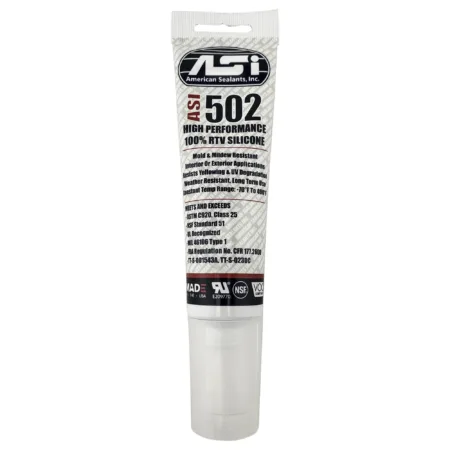
A food-safe silicone sealant is one whose manufacturer lists it for surfaces that food can touch, usually by stating that it meets NSF/ANSI Standard 51, the NSF standard for materials used in commercial food equipment, and FDA regulation 21 CFR 177.2600, which covers rubber articles intended for repeated use with food. Silicone is not food safe just because it is silicone; the listing on the data sheet is what counts. ASI 502 100% RTV silicone is one example: American Sealants Inc. lists both and calls it “acceptable as a sealant on surfaces with incidental food contact.”
Products in this guide
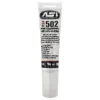 ASI 502 100% RTV Silicone Sealant, Clear, 2.8 oz Squeeze Tube Original price was: $10.90.$7.30Current price is: $7.30.
 ASI 502 100% RTV Silicone Sealant, Clear, 2.8 oz Squeeze Tube (Pack of 6) Original price was: $43.80.$24.99Current price is: $24.99.
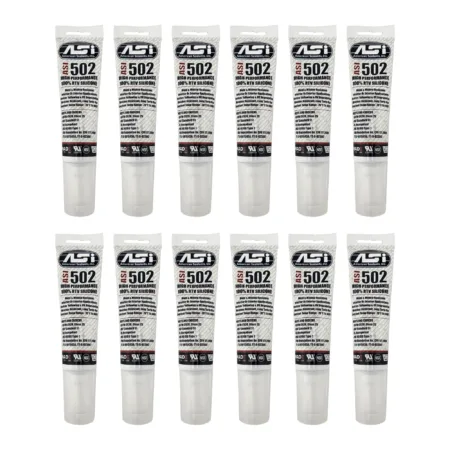
 ASI 502 100% RTV Silicone Sealant, Clear, 2.8 oz Squeeze Tube (Pack of 12) Original price was: $87.60.$47.99Current price is: $47.99.
Those listings do not cover drinking-water systems, which fall under NSF/ANSI 61 (not listed for 502), or lubricants, which are registered as NSF H1. Below: what each label means, where ASI 502 fits in a commercial kitchen or walk-in, and how to apply it.
What “food safe” means on a sealant label
There is no single “food safe” stamp for caulk. Whether a tube is sold as food safe or food grade silicone caulk, look for the named standard or regulation behind the claim, then check that it matches the job.
| Label | What it covers | ASI 502 (per ASI) |
|---|---|---|
| NSF/ANSI 51 | Materials used in commercial food equipment, sealants among them | Listed; acceptable as a sealant on surfaces with incidental food contact |
| FDA 21 CFR 177.2600 | Rubber articles intended for repeated use with food: permitted ingredients and extraction limits | Listed |
| NSF/ANSI 61 | Components that contact drinking water, such as pipes, fittings and plumbing products | Not listed |
| NSF H1 | Lubricants acceptable where incidental food contact may occur | Not applicable: a lubricant registration |
NSF/ANSI 51: food equipment materials
NSF/ANSI 51 is the standard for the materials that go into commercial food equipment. ASI’s data sheet names NSF Standard 51 for ASI 502 and calls it acceptable as a sealant on surfaces with incidental food contact: a joint sealant for food areas and equipment. ASI does not list it for making food molds, containers or utensils. If an inspector or specification asks for proof, request documentation from ASI or check NSF’s public listings; ASI’s data sheet notes that obtaining any government approval an application requires is the user’s responsibility.
FDA 21 CFR 177.2600: rubber articles for repeated use
This FDA regulation sets which substances may be used in rubber articles meant for repeated contact with food and how much may be extracted from them in testing. A cured silicone bead is rubber: ASI says 502 cures to form a durable solid rubber when exposed to moisture in the air. The regulation also says finished rubber articles for repeated food use are to be thoroughly cleansed before their first use in contact with food, a sensible habit for a freshly sealed joint as well.
NSF/ANSI 61 is for drinking water, and ASI 502 is not listed
Components that touch drinking water are covered by a separate standard, NSF/ANSI 61, and a listing to one standard is not a listing to the other. ASI’s data sheet names NSF Standard 51 for 502, not 61. ASI does include plumbing among 502’s common applications, but keep it out of anything that holds or carries drinking water, such as the inside of a water line, fitting or tank, and use a sealant listed to NSF/ANSI 61 there.
NSF H1 is a lubricant registration
NSF H1 is NSF’s category for lubricants acceptable where incidental food contact may occur, so it is not the listing to look for on a caulk. For lubricating O-rings, gaskets or slides on food equipment, see what NSF H1 means and our food grade grease and NSF H1 lubricants.
Is silicone caulk food safe?
Only when its maker says so. Silicone sealants differ in cure chemistry and formulation, and a data sheet that names neither NSF/ANSI 51 nor an FDA food-contact regulation gives you no basis for using it where food touches. Even within one brand the answer varies. In the ASI line we carry:
- ASI 502 (acetoxy cure) lists NSF Standard 51 and FDA 21 CFR 177.2600.
- ASI 509 Aquarium Sealant lists FDA 21 CFR 177.2600 but not NSF 51; ASI makes it for aquariums and terrariums, covered in our aquarium-safe silicone guide.
- ASI 388 Electronic Grade (neutral cure) lists neither, and ASI’s chemistry chart marks its neutral-cure silicones “not food grade.”
The same chart puts “food grade available” on the acetoxy side. Our acetoxy vs neutral cure silicone guide covers the other trade-offs.
Where ASI 502 fits in a kitchen, cooler or food plant
ASI’s listed applications for 502 include countertops, kitchen and bath, sanitary seals, refrigeration units, walk-in freezers, appliances, HVAC and ductwork. In a commercial kitchen or food plant, that covers jobs like these:
- Countertops, backsplashes and sinks: joints on solid-surface countertops, tile, ceramic, porcelain, marble, glass, steel and most metals. ASI rates it mold and mildew resistant and says it creates a waterproof seal.
- Walk-in coolers and freezers: panel seams and corners. ASI lists walk-in freezers and refrigeration units, gives a -70°F to 400°F service range (intermittent to 450°F) and an application range down to -35°F. Cold and low humidity slow the cure, so allow extra time in a box that stays cold.
- Equipment and ductwork: appliance seams, sheet metal, formed-in-place gaskets, HVAC and ductwork. It is non-slump, so it stays put on vertical and overhead joints.
Where not to use it: on porous surfaces such as concrete, mortar or brick; on any joint that must be painted, since ASI 502 is not paintable; and in confined spots around sensitive metals, because ASI notes that its acetoxy cure is corrosive to sensitive metals when confined.
How to apply it in a food area
- Take the area out of service. Remove the old sealant, then clean and dry the surface; ASI suggests 100% isopropyl alcohol or acetone, depending on the substrate, and says not to use petroleum-based solvents.
- Apply one continuous bead between -35°F and 150°F. A primer is not normally required; on an unfamiliar surface, ASI suggests a small trial bead and 7 days to judge adhesion.
- Tool the bead before it skins over. ASI measures skin formation at 10 minutes at 70°F and 50% relative humidity.
- Ventilate. ASI 502 gives off an acetic acid (vinegar) odor while it cures; use it only outdoors or in a well-ventilated area.
- Let it cure before food goes back. ASI gives 24 hours for a 1/8″ bead and says strength keeps building for 7 days; deeper or confined joints, cold and low humidity all take longer. ASI does not publish a separate waiting time for food contact, so we suggest waiting until the bead is cured through, then cleaning the surface as you would before any food service.
Tube, cartridge or multi-pack
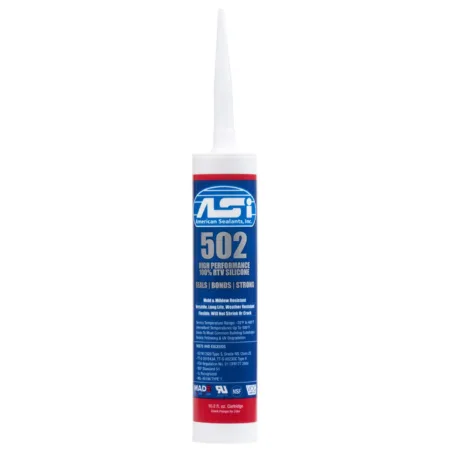
ASI’s 502 data sheet gives the NSF 51 and FDA listings for the product without separating colors or package sizes, so choose by the job. The clear 2.8 oz squeeze tube needs no caulking gun and suits short seams and touch-ups; white and black tubes match light or dark fixtures. For long runs such as walk-in panel seams, the clear 10.2 oz cartridge fits a standard caulking gun. Maintenance crews, restaurant groups and facilities that keep sealant at more than one site can order the clear tube as a 3-pack, 6-pack or 12-pack. ASI gives a shelf life of 12 months from shipment when stored at 70°F and 50% relative humidity, so buy for the work you have planned this year.
Frequently asked questions
Is silicone caulk food safe?
Only if its manufacturer lists it for food contact. Look for NSF/ANSI 51 or FDA 21 CFR 177.2600 on the data sheet; ASI 502 lists both and is described as acceptable as a sealant on surfaces with incidental food contact.
Is ASI 502 NSF 61 certified for drinking water?
No. ASI lists NSF Standard 51, the food equipment standard, not NSF/ANSI 61.
How long before food can touch it?
ASI gives no separate food-contact time. A 1/8″ bead cures in about 24 hours and keeps gaining strength for 7 days; wait until it is cured through, then clean the surface.
Can I use it in a walk-in cooler or freezer?
Yes. ASI lists walk-in freezers and refrigeration units and an application range down to -35°F; cold slows the cure.
Is a food-safe sealant the same as food grade grease?
No. A sealant’s food listing is a materials standard such as NSF/ANSI 51; a food grade lubricant carries an NSF H1 registration. For greases and oils, see our NSF H1 lubricants.
Bottom line
“Food safe” on a silicone sealant should point to a named listing. For joints in commercial kitchens, food equipment and walk-ins, ASI 502 lists NSF Standard 51 and FDA 21 CFR 177.2600 and is acceptable as a sealant on surfaces with incidental food contact. It is not listed for drinking water, it cannot be painted, and it needs a full cure before food goes back. For other jobs, browse the full ASI silicone range.
Products in this guide
-
ASI
ASI 502 100% RTV Silicone Sealant, Clear, 2.8 oz Squeeze Tube
Original price was: $10.90.$7.30Current price is: $7.30.In stock — ships in 1–2 days
Add to cart -
ASI
ASI 502 100% RTV Silicone Sealant, Clear, 2.8 oz Squeeze Tube (Pack of 6)
Original price was: $43.80.$24.99Current price is: $24.99.$4.17 / tube
In stock — ships in 1–2 days
Add to cart -
ASI
ASI 502 100% RTV Silicone Sealant, Clear, 2.8 oz Squeeze Tube (Pack of 12)
Original price was: $87.60.$47.99Current price is: $47.99.$4.00 / tube
In stock — ships in 1–2 days
Add to cart -
ASI
ASI 502 100% RTV Silicone Sealant, Clear, 10.2 oz Cartridge
Original price was: $16.90.$12.99Current price is: $12.99.Out of stock
Read more

Sources
- ASI 502 technical data sheet (American Sealants Inc. / Meridian Adhesives Group)
- ASI 502 product page
- ASI general RTV silicone properties: acetoxy vs neutral cure chart
- ASI 509 Aquarium Sealant technical data sheet
- ASI 388 Electronic Grade Silicone technical data sheet
- 21 CFR 177.2600, Rubber articles intended for repeated use (eCFR)