For most O-rings in water, air and vacuum service, including nitrile (NBR), EPDM, fluorocarbon (FKM, often sold as Viton), neoprene and butyl, a silicone O-ring grease is the safe default. The two big exceptions: keep petroleum products, petroleum jelly included, off EPDM and butyl, and take care with silicone O-rings, because Super Lube rates its silicone O-ring products not compatible with silicone rubber. When in doubt, match the lubricant to the seal material and follow the equipment maker.
Lubricant by O-ring material
| O-ring material | Silicone grease | Petroleum grease or petroleum jelly | Notes |
|---|---|---|---|
| Nitrile (NBR, Buna-N) | Yes. Super Lube rates nitrile Excellent | Yes. Parker lists nitrile as resistant to petroleum and mineral oils and greases | The most common general-purpose O-ring |
| EPDM | Yes. Super Lube: Excellent; Parker: resistant to silicone oil and grease | No. Parker: not compatible with mineral oil products (oils, greases and fuels) | Common in water, steam and glycol brake-fluid service |
| Fluorocarbon (FKM, Viton) | Yes. Super Lube: Excellent; Parker: resistant | Yes. Parker: resistant to mineral oil and grease | Parker lists petrolatum and silicone lubricants for FKM |
| Neoprene (CR) | Yes. Super Lube: Excellent; Parker: resistant | Generally yes. Parker lists paraffin-based mineral oil as compatible and petrolatum as a lubricant | Parker rates naphthenic mineral oils as limited compatibility |
| Butyl (IIR) | Yes. Super Lube: Excellent; Parker: resistant | No. Parker: not compatible with mineral oil and grease | Very low gas permeability, per Parker |
| Silicone (VMQ) | Caution. Super Lube rates silicone rubber not compatible; Parker lists low molecular weight silicone oils as not compatible | Parker lists petrolatum, and a fluorosilicone grease, as lubricants for silicone seals | Ask the seal or equipment maker |
One nuance on silicone seals: Parker’s handbook says its own high-viscosity silicone oil, Super-O-Lube, can be used on all rubber polymers including silicones, with a note that silicones require special consideration. Because the guidance differs between manufacturers, treat silicone-on-silicone as a question for the seal maker, not a default.
Why lubricate O-rings at all
Parker’s O-Ring Handbook puts it simply: the greatest benefit of a lubricant comes during installation. A suitable grease or oil helps protect the O-ring from abrasion, pinching and cutting, helps it seat properly and leaves a protective surface film. Lubrication is close to essential in dynamic pneumatic service, and in vacuum work it helps reduce the leak rate. Parker also says a light film is all that’s required.
Our O-ring lubricants
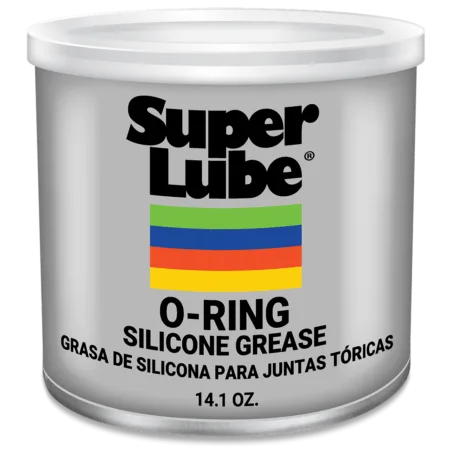
- Super Lube 93016 O-Ring Silicone Grease, 14.1 oz canister: an NLGI 2 non-curing silicone compound, rated -40°F to 500°F (-40°C to 260°C), NSF H1 registered (#156444). Super Lube’s data sheet lists water washout under 1%, describes it as safe in potable water, and notes it can act as a vacuum chamber sealant.
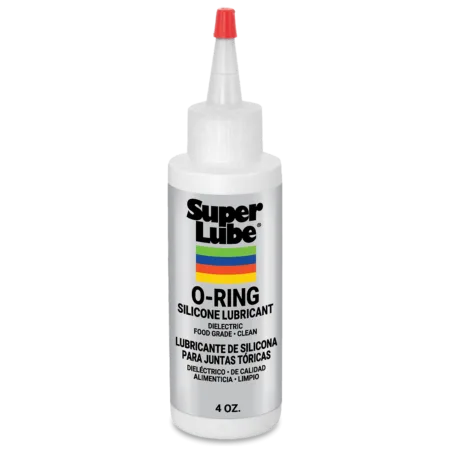
- Super Lube 56204 O-Ring Silicone Lubricant, 4 oz bottle: a clear, non-curing 5,000 cSt silicone fluid for a thinner film, rated -58°F to 392°F (-50°C to 200°C), NSF H1 registered (#156449).
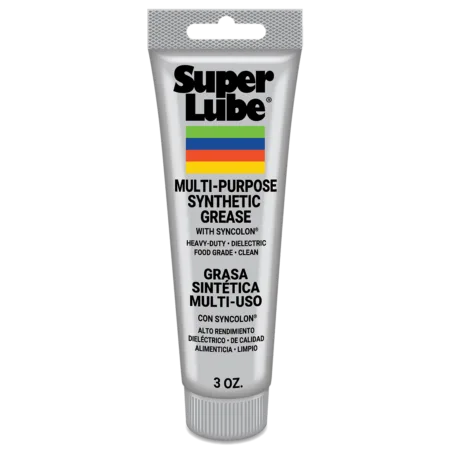
- Super Lube 21030 Multi-Purpose Synthetic Grease with Syncolon: a silicone-free NLGI 2 synthetic grease with PTFE whose data sheet lists O-ring lubrication among its uses. Its data sheet doesn’t publish a silicone-rubber rating, so test it before using it on silicone seals.
The two O-ring products carry the same compatibility chart: Excellent with nitrile, EPDM, FKM, neoprene, natural rubber, butyl and SBR, and with most common plastics; Good with acetal (Delrin) and PPS; not compatible with silicone rubber.
Common jobs
- Pool and spa filters and pumps: Hayward recommends a silicone or PTFE (Teflon) based lubricant for all its O-rings and gaskets and says never to use petroleum jelly. Super Lube lists pool pump and filter seals among the uses for 93016 and 56204.
- Faucet valves and water softener valves: both appear in Super Lube’s typical applications for its O-ring products.
- Vacuum seals: for static vacuum face seals, Parker recommends a silicone grease as a seating lubricant and surface coating.
- Oxygen service: use only a lubricant approved for oxygen. Super Lube’s synthetic grease data sheet says it is not for use in a pure oxygen environment, and none of the products in this guide is sold for oxygen service.
How to grease an O-ring
- Clean the groove and the mating surfaces, as Super Lube’s directions specify.
- Inspect the O-ring. Replace it if it’s cracked, flattened, nicked or swollen.
- Apply a light, even film all the way around the ring. More doesn’t seal better.
- Lightly coat the surface the ring slides over during assembly to help prevent pinching.
- Don’t mix greases. Super Lube’s directions for 93016 say not to mix it with other greases.
Frequently asked questions
Can you use Vaseline on O-rings?
It depends on the material. Parker lists petrolatum as a lubricant for nitrile, neoprene, FKM and silicone, but EPDM and butyl are not compatible with mineral oil products, and Hayward says never to use petroleum jelly on its pool equipment.
Can I use dielectric grease on O-rings?
Super Lube 91003 dielectric grease lists rubber gaskets and plug valves among its uses and is a silicone compound, so the same material cautions apply: fine on most rubbers, but check before using it on silicone seals.
Should O-rings be lubricated?
Usually, yes, especially at installation, according to Parker. The exceptions Parker names are systems where a lubricant would be unacceptable contamination, such as semiconductor processing equipment, medical devices and food processing devices.
Bottom line
Silicone O-ring grease is the safe default for nitrile, EPDM, FKM, neoprene and butyl. Keep petroleum products off EPDM and butyl, don’t put silicone on silicone seals without the maker’s approval, and use a thin film. Shop all O-ring lubricants and silicone O-ring greases, compare Super Lube greases, and download data sheets from our technical documents page.
Sources
- Parker Hannifin, Parker O-Ring Handbook ORD 5700 (2021), sections 2.2 and 3.1.5: PDF
- Kano Laboratories, Super Lube O-Ring Silicone Grease technical data sheet (March 2024): FACTOVAL technical documents page
- Super Lube, O-Ring Silicone Grease product page: super-lube.com
- Super Lube, O-Ring Silicone Lubricant product page: super-lube.com
- Kano Laboratories, Super Lube Multi-Purpose Synthetic Grease with Syncolon technical data sheet: FACTOVAL technical documents page
- Kano Laboratories, Super Lube Silicone Dielectric and Vacuum Grease technical data sheet: FACTOVAL technical documents page
- Hayward, “What should I use as a lubricant for my o-rings and gaskets?”: hayward.com
Products in this guide
-
Super Lube
Super Lube 93016 O-Ring Silicone Grease, 14.1 oz Canister
$30.99In stock — ships in 1–3 days
- NSF H1 food grade
- Dielectric
-
Super Lube
Super Lube 56204 O-Ring Silicone Lubricant, 4 oz Bottle
Original price was: $14.99.$11.99Current price is: $11.99.In stock — ships in 1–3 days
- NSF H1 food grade
- Dielectric
-
Super Lube
Super Lube 21030 Multi-Purpose Synthetic Grease with Syncolon, 3 oz Tube
$11.99In stock — ships in 1–3 days
- NSF H1 food grade
- Dielectric