Dielectric grease goes where you want to keep moisture, dirt and air out of an electrical connection and stop rubber parts from sticking: inside spark plug and coil-on-plug boots, on the seals of multi-pin and trailer connectors, in bulb sockets, and over terminal strips and battery connections. It is an insulator, not a conductor, so it seals a connection that is already clean and tight. It does not repair a bad one.
What dielectric grease does, and what it doesn’t
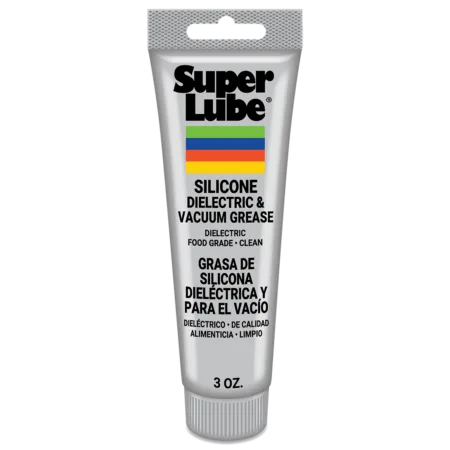
Take Super Lube 91003 Silicone Dielectric and Vacuum Grease as the example. Super Lube describes it as a non-curing silicone compound that seals, protects and insulates electrical components and connectors and forms a waterproof barrier against moisture and contaminants. Its technical data sheet lists a dielectric strength of 777 V/mil (ASTM D149), a temperature range of -40°F to 500°F (-40°C to 260°C) and NSF H1 registration (#141973). Because it insulates, it is not a heat-transfer paste and it won’t carry current across a gap; those jobs need different products.
Where to put it: quick reference
| Location | Where exactly | Why |
|---|---|---|
| Spark plug boots | A thin, even coat inside the boot, from the terminal end to the boot’s edge; wipe off excess | Keeps the boot from bonding to the porcelain and helps prevent arcing and carbon tracking |
| Coil-on-plug boots | Same: a thin coat inside the rubber boot (one GM bulletin specifies up to 15 mm deep for its engine) | Same as above |
| Multi-pin connectors: headlights, sensors, trailer plugs | On a clean, dry connector, a thin film on the weather seal and around the terminals; don’t pack the cavity | Seals out water and road salt |
| Bulb sockets | A light film around the bulb base and socket seal | Super Lube lists light bulbs among its applications |
| Battery cables and terminals | Clean and tighten first, then coat the outside of the joint | Corrosion barrier; a connector gel made for terminals is another option |
| Terminal strips, disconnects, enclosure gaskets | A thin coat over exposed terminals and rubber gaskets | Moisture barrier; listed in Super Lube’s typical applications |
Spark plug and coil boots, step by step
- Work on a cool engine and remove one boot at a time so wires and coils stay in the right order.
- Inspect the boot. A cracked boot or one with carbon tracks should be replaced; grease won’t fix it.
- Wipe old residue off the plug insulator and out of the boot.
- Apply a thin coat inside the boot and spread it evenly from the terminal end toward the edge. GM’s TechLink bulletin on this repair stresses not to use an excessive amount and to remove extra grease from around the end of the boot.
- Push the boot on until it seats fully, then wipe away anything that squeezed out.
- Check your service information. Some automakers specify a particular grease for their coils; GM’s bulletin, for example, names a specific product for the engines it covers. If your manual does, use what it calls for.
Plug-in connectors and trailer plugs, step by step
- Disconnect the connector, following the service manual if it calls for disconnecting the battery first.
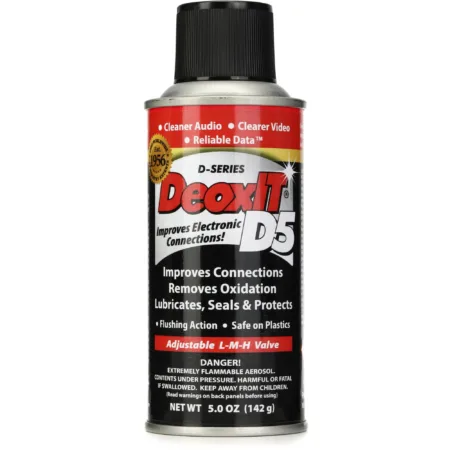
- Look at the pins. If they’re green, white or black with corrosion, clean them first. CAIG describes DeoxIT D5S-6 contact cleaner spray as removing oxidation and corrosion from metal contacts, with a flushing spray.
- Let everything dry, then apply a thin film to the rubber seal and around the terminals.
- Reconnect fully so the locking tab clicks, and wipe off excess so it doesn’t collect grit.
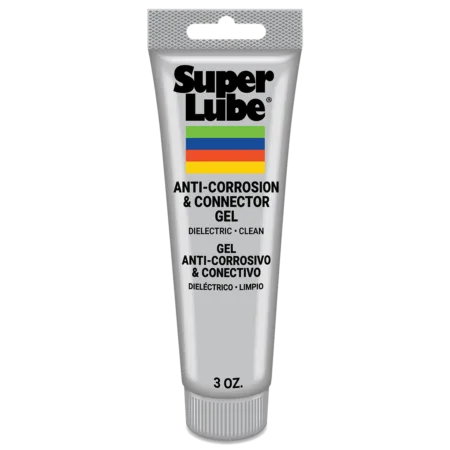
For battery terminals, Super Lube’s own answer is a different product: Super Lube 82003 Anti-Corrosion and Connector Gel, a translucent amber NLGI 0 gel rated -45°F to 500°F (-43°C to 260°C), applied to a clean, dry area until it is completely covered. Super Lube notes that 82003 should not be used as a lubricant. Our guide to preventing corrosion on electrical connections compares the two.
Where dielectric grease does not belong
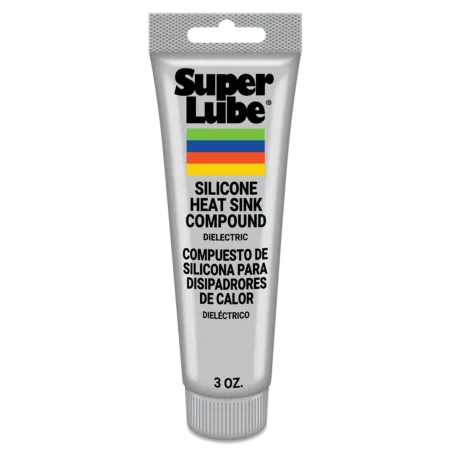
- Between a hot component and its heat sink. That’s a job for a thermally conductive paste such as Super Lube 98003 Heat Sink Compound; see heat sink compound vs thermal paste.
- As a fix for a loose or corroded connection. It insulates; clean and tighten first.
- Where the connector or vehicle maker says otherwise. If a service manual specifies a different compound or a dry connector, follow it.
- In thick globs. Excess attracts dirt and makes the next repair messier.
Frequently asked questions
Is dielectric grease conductive?
No. It is an insulator; Super Lube rates 91003 at 777 V/mil dielectric strength. It protects the connection around the contacts rather than carrying current itself.
Is dielectric grease the same as silicone grease?
Super Lube 91003 is a silicone compound, so it is a type of silicone grease, but it is formulated for electrical and vacuum work. Super Lube’s general-purpose silicone grease, 92003, lists 400 V/mil and adds Syncolon (PTFE) for lubrication.
How much dielectric grease should I use?
A thin, even coat. Super Lube’s directions for 91003 are simply to clean the surfaces and apply evenly, and GM’s bulletin on coil boots warns against using an excessive amount and says to wipe off any extra.
Does dielectric grease dry out?
Super Lube describes 91003 as non-curing, and its data sheet lists a five-year recommended shelf life in the original container. Re-apply whenever you separate and service a connection.
Bottom line
Put dielectric grease on boots, seals, sockets and the outside of finished connections, in thin coats, after the metal is clean and the joint is tight. Keep it off heat sinks and out of loose or dirty connections. Shop all dielectric greases and connector protectants, and download data sheets from our technical documents page.
Sources
- Super Lube, Silicone Dielectric and Vacuum Grease product page: super-lube.com
- Kano Laboratories, Super Lube Silicone Dielectric and Vacuum Grease technical data sheet (March 2024): FACTOVAL technical documents page
- Kano Laboratories, Super Lube Anti-Corrosion and Connector Gel technical data sheet (March 2024): FACTOVAL technical documents page
- Kano Laboratories, Super Lube Silicone Lubricating Grease technical data sheet: FACTOVAL technical documents page
- GM TechLink, “Use Dielectric Grease to Prevent Spark Plug Carbon Tracking” (December 2019): gm-techlink.com
- CAIG Laboratories, DeoxIT D5S-6 data sheet and product page: caig.com
Products in this guide
-
Super Lube
Super Lube 91003 Silicone Dielectric & Vacuum Grease, 3 oz Tube
$15.99In stock — ships in 1–3 days
- NSF H1 food grade
- Dielectric
-
Super Lube
Super Lube 82003 Anti-Corrosion & Connector Gel, 3 oz Tube
$13.99In stock — ships in 1–3 days
- Made in USA
-
DeoxIT
DeoxIT D5S-6 Contact Cleaner Spray with L-M-H Valve, 5 oz
$22.99In stock — ships in 1–3 days
- Ground ship only
-
Super Lube
Super Lube 98003 Heat Sink Compound, 3 oz Tube
$11.99In stock — ships in 1–3 days
- Made in USA