
To prevent corrosion on electrical connections, clean the contact surfaces first, then keep moisture and air away from them: a dielectric grease to seal connector bodies, boots and gaskets; a connector gel to coat battery terminals and exposed terminals; and a corrosion-inhibitor spray to leave a protective film on bolts, brackets and other bare metal. Check the connection once or twice a year and reapply. The right product depends on whether the part is a sealed connector, an open terminal or general metal hardware.
Products in this guide
All 4 products in this guide ↓
Why connections corrode
Corrosion needs metal, moisture and oxygen, and it speeds up with road salt, sea air, battery acid vapor and pollution. On a connector, even a thin layer of oxide raises resistance, which causes voltage drop, heat, flickering lights, crackling audio and intermittent faults. Vibration makes it worse: CAIG describes fretting corrosion, where tiny movements between contacts wear through plating and expose fresh metal to oxidize. Protection works by keeping water and air off the metal and by sealing out contaminants.
Step 1: clean before you protect
Any protector sealed over existing corrosion locks the problem in. Start with a clean, dry, bright surface:
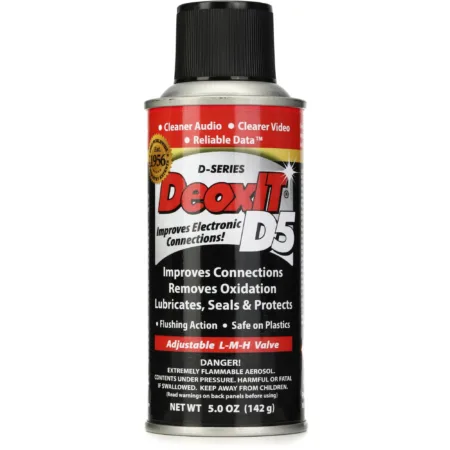
- Connector pins and sockets: a contact treatment such as the DeoxIT D5S-6 contact cleaner spray. CAIG’s directions: power off, one short burst, work the connector, another short burst, wait two minutes before powering up. For heavy oxidation CAIG says you may need to leave it overnight and wipe off the lifted residue.
- Battery terminals and posts: disconnect the cable, scrub off the white or green buildup with a terminal brush, rinse and dry.
- Bolts, brackets and hardware: wire-brush loose rust and wipe off dirt and oil.
Our guide to what DeoxIT is used for covers contact cleaning in more detail.
Step 2: pick the right protector
| Product (Super Lube data) | Form | Use it on | Key facts |
|---|---|---|---|
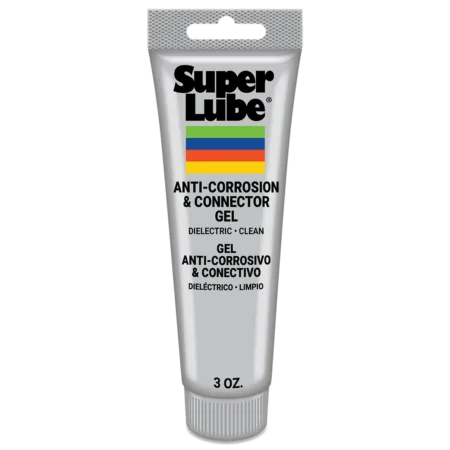
| Super Lube 82003 Anti-Corrosion and Connector Gel | Thin NLGI 0 gel, translucent amber, 3 oz tube | Battery terminals, terminal strips, fuse holders, circuit breakers, switches, sockets, exposed metal | -45°F to 500°F; resists salt water and most detergents; not a lubricant |
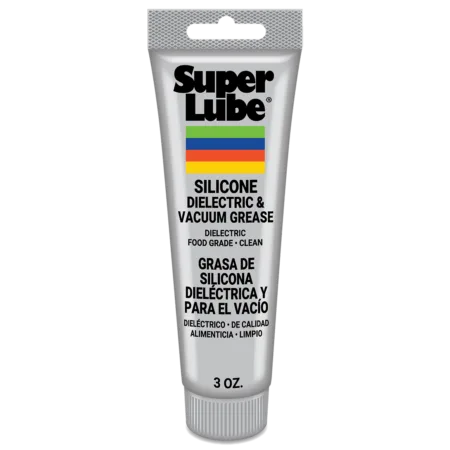
| Super Lube 91003 Silicone Dielectric and Vacuum Grease | NLGI 2 silicone grease, 3 oz tube | Connector bodies and seals, spark plug and coil boots, battery cables, bulb sockets, rubber gaskets | -40°F to 500°F; 777 V/mil dielectric strength; NSF H1 (#141973) |
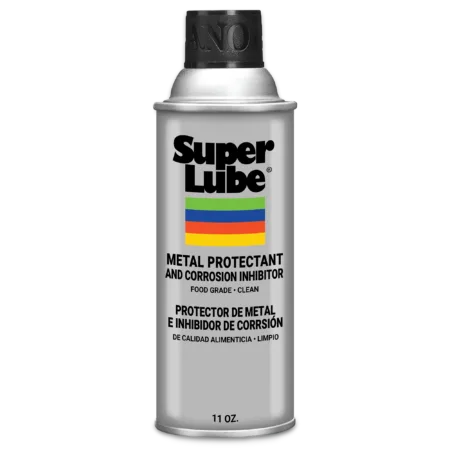
| Super Lube 83110 Metal Protectant and Corrosion Inhibitor | Synthetic penetrating oil, 11 oz aerosol | Nuts, bolts, tools, locks, hinges, chains, battery terminals, equipment in storage | Passes 500-hour salt spray (ASTM B117); copper corrosion 1A (ASTM D130) |
Battery terminal grease vs dielectric grease
Both keep moisture and corrosive vapor off the metal, but they are built differently. Super Lube describes 82003 as a high molecular weight connector gel used as a dielectric compound and corrosion inhibitor; its thin NLGI 0 consistency makes it easy to coat a terminal completely, and it stays pliable without hardening, cracking or separating. That makes it the better fit for battery posts and clamps, terminal strips and other open terminals. Super Lube is explicit that 82003 should not be used as a lubricant.
91003 is a thicker, non-curing silicone grease that seals, protects and insulates connectors and is waterproof. It is the better fit inside rubber boots and on connector seals and gaskets, because it is compatible with most plastics and rubbers and stays where you put it. Either one works on a battery cable end; use 82003 when you want full coverage of an exposed terminal, 91003 when the protection lives inside a boot or a sealed housing.
Where to put dielectric grease
Dielectric grease is an insulator; its job is to seal, not to carry current. Apply a light film to the connector seal, the inside of the rubber boot and the housing faces that meet when the connector closes. A thin coat on the terminals before mating is common practice because the contacts wipe through it as they engage, but do not pack the connector solid. Super Lube lists electrical assemblies and terminals, cable connections, battery cables, spark plugs, distributor caps, light bulbs and terminal strips among 91003’s applications. Our dielectric grease page groups these products.
One thing dielectric grease is not: a heat transfer paste. If a module bolts to a heat sink, it needs a thermal compound instead; see heat sink compound vs thermal paste.
Protecting a battery: the order that works
- Disconnect the negative cable first, then the positive.
- Clean the posts and clamps until bright, rinse off any residue and dry them.
- Reconnect positive first, then negative, and tighten the clamps.
- Coat the posts, clamps and exposed cable ends with 82003 until the area is completely covered, as Super Lube’s directions describe.
- Inspect at oil changes or seasonally, and reapply as needed.
Metal parts, hardware and equipment in storage
For bare metal rather than electrical contacts, a corrosion-inhibitor spray is easier than grease. Super Lube 83110 is a synthetic penetrating oil that creates a moisture-displacing barrier on steel, aluminum and other metals and leaves a protective lubricating film. Super Lube recommends applying it before storing or shipping equipment, to protect it from heat and humidity, and lists battery terminals, nuts and bolts, tools, locks, hinges, chains, garage door slides and metal fabrication among its uses. Its data sheet reports a pass in a 500-hour ASTM B117 salt spray test and a 1A rating in the ASTM D130 copper corrosion test. Apply liberally and allow time to soak, per the directions. It is an extremely flammable aerosol, so use it with ventilation and away from ignition sources, and it ships by ground to the contiguous US only.
Frequently asked questions
How do I stop battery terminal corrosion?
Clean the posts and clamps, reconnect and tighten them, then coat the whole terminal with a connector gel such as Super Lube 82003 and reinspect seasonally.
Is dielectric grease conductive?
No. Super Lube 91003 is an insulator with a dielectric strength of 777 V/mil; it protects the connection by sealing out moisture.
Can I use a corrosion inhibitor spray on electrical connections?
Super Lube lists battery terminals among 83110’s uses. For sealed connectors and boots, a dielectric grease is the more common choice.
Should I clean connections before applying grease?
Yes. Grease applied over existing oxidation seals it in. Clean with a contact treatment or brush first.
Bottom line
Clean first, then protect: connector gel (82003) on battery and open terminals, silicone dielectric grease (91003) in boots, seals and connectors, and a corrosion-inhibitor spray (83110) on bare metal and stored equipment. Inspect and reapply on a schedule. The gel and the dielectric grease are on our contact cleaners and protectants page; the spray is with our other Super Lube products.
Products in this guide
-
DeoxIT
DeoxIT D5S-6 Contact Cleaner Spray with L-M-H Valve, 5 oz
Original price was: $20.99.$19.30Current price is: $19.30.In stock — ships in 1–3 days
- Ground ship only
-
Super Lube
Super Lube 82003 Anti-Corrosion & Connector Gel, 3 oz Tube
Original price was: $14.39.$13.89Current price is: $13.89.Out of stock
- Made in USA
-
Super Lube
Super Lube 91003 Silicone Dielectric & Vacuum Grease, 3 oz Tube
$15.99Out of stock
- NSF H1 food grade
- Dielectric
-
Super Lube
Super Lube 83110 Metal Protectant & Corrosion Inhibitor, 11 oz Aerosol
Original price was: $20.90.$17.39Current price is: $17.39.Out of stock
- Ground ship only
- NSF H1 food grade
Sources
- Super Lube Anti-Corrosion and Connector Gel, technical data sheet
- Super Lube Silicone Dielectric and Vacuum Grease, technical data sheet
- Super Lube Metal Protectant and Corrosion Inhibitor, product page
- Super Lube Metal Protectant and Corrosion Inhibitor, technical data sheet
- Super Lube Metal Protectant and Corrosion Inhibitor aerosol, safety data sheet
- CAIG Laboratories: DeoxIT D5S-6 product page