
DeoxIT is used to clean and protect electrical contacts: the D-Series removes oxidation and corrosion from metal contacts and connectors, improves conductivity, and leaves a thin film that protects the surface and reduces intermittent connections, arcing and noise. It is made by CAIG Laboratories in the USA and is used on audio and video gear, computers, communication equipment, automotive and marine electrical systems, avionics and test equipment. CAIG makes separate versions for plated contacts (Gold) and for conductive plastic faders (Fader F-Series).
Products in this guide
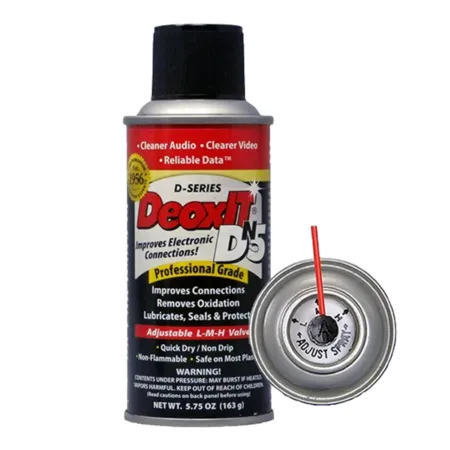
 DeoxIT D5S-6 Contact Cleaner Spray with L-M-H Valve, 5 oz Original price was: $20.99.$19.30Current price is: $19.30.
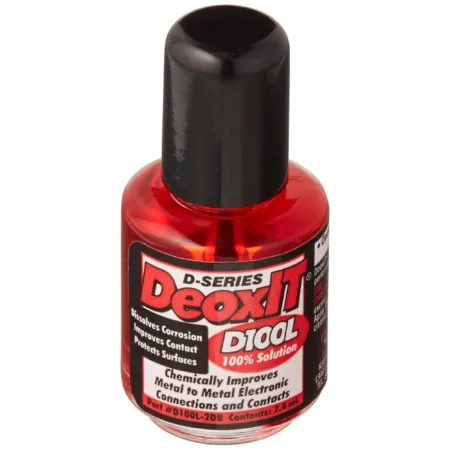
 DeoxIT D100L-2DB 100% Contact Cleaner, 7.4 mL Brush Applicator Original price was: $20.99.$19.30Current price is: $19.30.
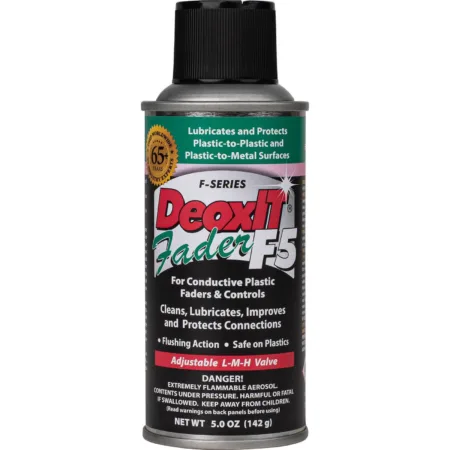
 DeoxIT F5S-H6 FaderLube Spray, 5 oz Original price was: $21.99.$20.99Current price is: $20.99.
How DeoxIT works
Metal contacts oxidize and corrode over time, and that thin layer of oxide raises resistance. The symptoms are familiar: crackling audio, a switch that only works when wiggled, a flickering light, a connector that drops out with vibration. CAIG describes DeoxIT D-Series as a contact treatment, rejuvenator, conductivity enhancer and lubricant that removes oxidation and corrosion from metal surfaces, fills in microscopic gaps and reseals the surface for better contact.
The active concentrate, DeoxIT D100L, has about 20% chemical deoxidizing action according to CAIG. When it has dissolved heavy oxidation, CAIG notes you may see green or black coloration on the surface or the swab, which tells you to repeat the treatment until it wipes clean.
What DeoxIT is used for
- Audio and video: RCA, XLR and 1/4-inch jacks and plugs, speaker terminals, patch bays, input selectors and switch contacts.
- Computers and electronics: edge connectors, ribbon and board-to-board connectors, sockets, battery contacts in remotes and handheld devices.
- Automotive, RV and marine: wiring harness connectors, fuse holders, switches, trailer plugs and lighting connections.
- Around the home and shop: power tool battery contacts, low-voltage lighting, chargers, pool equipment connections and wall-plug contacts.
- Industrial and field service: controls, relays and connectors in avionics, medical, security and communication equipment, which are among the industries CAIG lists on its data sheets.
Which DeoxIT for which job
| CAIG line | What it does | Use it on |
|---|---|---|
| D-Series (D5, DN5, D100L) | Deoxidizes, cleans, protects (about 20% deoxidizing) | Metal contacts that have been in service or show oxidation |
| Gold G-Series (G5) | Conditions and protects (about 0.5% deoxidizing) | New, clean or plated contacts, including gold |
| Fader F-Series (F5, F100L) | Lubricates; not a deoxidizer | Conductive plastic and carbon faders and potentiometers |
| Shield S-Series (not stocked) | Protects in severe environments | Clean contacts exposed to humidity, salt and pollution |
For a common starting point, the DeoxIT D5S-6 5% spray flushes and treats metal contacts; the DeoxIT DN5S-6N non-flammable spray does the same with a non-flammable carrier for work inside equipment; and the DeoxIT D100L-2DB brush applicator applies the solvent-free 100% liquid where overspray is a problem. For noisy faders and pots, use the DeoxIT F5S-H6 FaderLube. Our D-Series guide compares D5, DN5, D100L and Gold in detail.
What is DeoxIT made of?
CAIG lists the D5S-6 spray as 5% DeoxIT D100L, 75% odorless mineral spirits and 20% difluoroethane propellant. DN5S-6N uses the same 5% D100L with a non-flammable Solstice PF carrier. The D100L concentrate itself is a proprietary formula: its safety data sheet lists it as 100% DeoxIT D100L, non-volatile and non-flammable, with an eye-irritation warning. The solvent in the sprays carries the DeoxIT into the contact and flushes debris out, then evaporates.
Does DeoxIT leave a residue?
Yes, by design. The protective part of DeoxIT is meant to stay on the metal as a thin film. CAIG’s Quick Specs list the D100L concentrate at 0% volatile by weight, so it does not evaporate; only the spray’s solvent does. CAIG’s directions are to apply, work the part, wipe away the loosened contamination, reapply and then wipe off the excess so only a thin layer remains.
Is DeoxIT safe on plastic?
Mostly, with testing. CAIG describes the 100% D100L formula as safe on plastics and rates it excellent on ABS, nylon, polycarbonate, phenolic, epoxy, POM, PP, PTFE and PVC, good on HDPE and LDPE, fair on acrylic (PMMA) and polystyrene, and poor on TPE, rubber and varnish. The solvent in the D5 spray lowers ABS and polycarbonate to fair-to-good and may swell rubber until it evaporates. CAIG advises testing first on vintage equipment with aging ABS plastic and notes that acrylics, ABS and polycarbonate under stress may show slight cracking or crazing.
Can DeoxIT cause a short?
The DeoxIT film itself is not a conductor. CAIG’s Quick Specs give the D100L concentrate a dielectric strength of 341 volts per mil and a very low electrical conductivity. What matters is the solvent in the sprays: D5 is an extremely flammable aerosol until the solvent evaporates, so CAIG’s directions say to treat equipment with the power off and unplugged and to wait two minutes before turning it back on.
Where not to use DeoxIT D-Series
- On conductive plastic faders and carbon pots as the only treatment; use the Fader F-Series for the track (see DeoxIT D5 vs F5).
- As a mechanical lubricant for bearings, gears or hinges; use a grease or oil.
- On live equipment, or near sparks and flames while a solvent spray is still wet.
- On rubber, TPE and varnished parts without testing.
- To fix problems that are not oxidation: a cracked solder joint, a broken wire or a worn-through track will still need repair.
Does DeoxIT go bad?
CAIG’s Quick Specs list a shelf life of 3 to 5 years for the D-Series and suggest reapplying treated contacts every 1 to 3 years in general use, sooner in harsh environments. Store aerosols away from heat; CAIG’s SDS says to avoid temperatures above 120°F.
Frequently asked questions
Does DeoxIT really work?
On oxidized metal contacts, yes: the D100L concentrate has about 20% deoxidizing action per CAIG. It will not fix broken solder joints or worn parts.
Does DeoxIT lubricate?
Lightly. CAIG calls the D-Series a contact rejuvenator, lubricant and protectant, so it reduces wear on contacts, but it is not a substitute for mechanical grease or oil.
Is DeoxIT flammable?
The D5 and Gold G5 aerosols are extremely flammable until the solvent evaporates. DN5 and the 100% D100L liquids are non-flammable.
How long does a DeoxIT treatment last?
CAIG’s general recommendation is to reapply every 1 to 3 years, depending on the environment.
Bottom line
DeoxIT D-Series is a contact cleaner and protectant for oxidized metal connections; Gold protects new and plated contacts; the Fader series lubricates conductive plastic controls. Use it with power off, wipe it down to a thin film, and test on sensitive plastics. Browse the full range on our contact cleaners page.
Products in this guide
-
DeoxIT
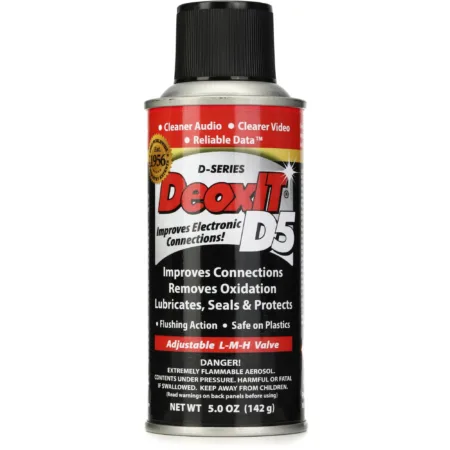
DeoxIT D5S-6 Contact Cleaner Spray with L-M-H Valve, 5 oz
Original price was: $20.99.$19.30Current price is: $19.30.In stock — ships in 1–3 days
- Ground ship only
-
DeoxIT
DeoxIT DN5S-6N Non-Flammable Contact Cleaner Spray, 5.75 oz
$28.99Out of stock
- Ground ship only
-
DeoxIT
DeoxIT D100L-2DB 100% Contact Cleaner, 7.4 mL Brush Applicator
Original price was: $20.99.$19.30Current price is: $19.30.In stock — ships in 1–3 days
- Dielectric
-
DeoxIT
DeoxIT F5S-H6 FaderLube Spray, 5 oz
Original price was: $21.99.$20.99Current price is: $20.99.In stock — ships in 1–3 days
- Ground ship only
Sources
- CAIG Laboratories: DeoxIT D5S-6 product page
- CAIG Laboratories: DeoxIT DN5S-6N product page
- CAIG Laboratories: DeoxIT D100L-2DB product page
- CAIG Laboratories: DeoxIT D100L data sheet
- CAIG Laboratories: DeoxIT D100L safety data sheet
- CAIG Laboratories: DeoxIT Quick Specs (SB-D-ISCT-B, 5/2023)
- CAIG Laboratories: DeoxIT Fader F-Series product information sheet