
DeoxIT D5, DN5 and D100L all contain the same active ingredient, DeoxIT D100L; what changes is how it is delivered. D5 is a 5% solution in a flammable solvent spray that flushes contacts clean, DN5 is a 5% spray with a non-flammable, fast-drying carrier for work on or inside equipment, and D100L is the 100% liquid with no solvents, applied by needle, brush or tube where overspray is a problem. DeoxIT Gold G5 is a different formula for new or plated contacts, not for heavy oxidation.
Products in this guide
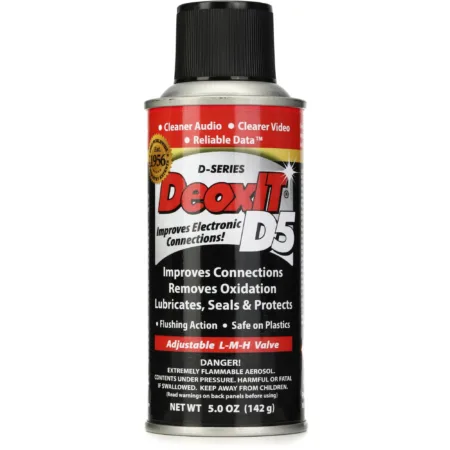
 DeoxIT D5S-6 Contact Cleaner Spray with L-M-H Valve, 5 oz Original price was: $20.99.$19.30Current price is: $19.30.
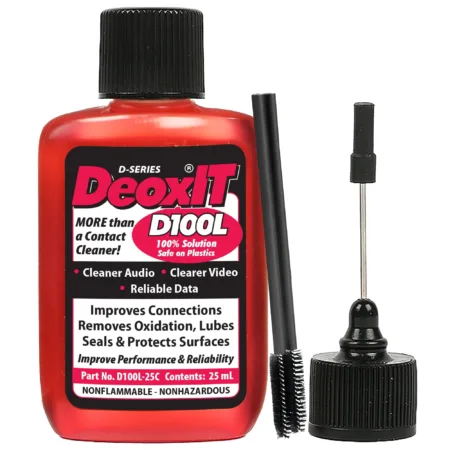
 DeoxIT D100L-25C 100% Contact Cleaner, 25 mL Precision Needle Dispenser Original price was: $34.99.$29.99Current price is: $29.99.
D5 vs DN5 vs D100L vs Gold G5 at a glance
| Product | Formula (CAIG) | Flammability | Good fit for |
|---|---|---|---|
| DeoxIT D5S-6, 5 oz spray | 5% D100L, 75% odorless mineral spirits, 20% propellant; flushing action | Extremely flammable aerosol until the solvent evaporates | Connectors and parts removed from equipment or easy to reach; flushing out dirt |
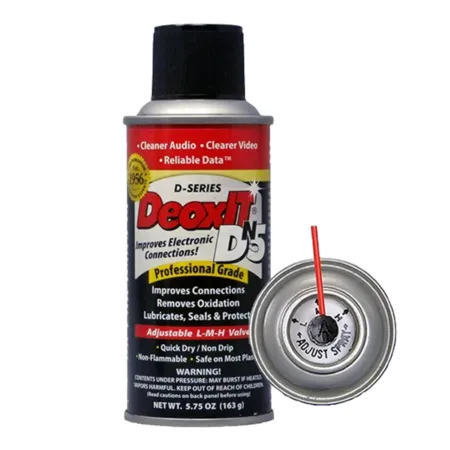
| DeoxIT DN5S-6N, 5.75 oz spray | 5% D100L, 75% Solstice PF carrier, 20% propellant; quick dry, non-drip | Non-flammable | Delicate connectors on and in equipment; parts near rubber |
| DeoxIT D100L-25C, 25 mL needle | 100% D100L, no solvents, 0% VOC | Non-flammable | Pin-point drops on accessible contacts; no overspray |
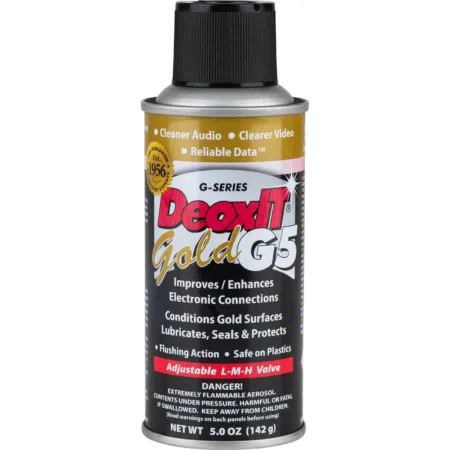
| DeoxIT Gold G5S-6, 5 oz spray | 5% G100L, 75% odorless mineral spirits, 20% propellant | Extremely flammable aerosol | Gold-plated and other plated contacts; new or already-cleaned surfaces |
The D5, DN5 and G5 sprays each give about 1,200 applications according to CAIG, and all have a Low-Med-High adjustable valve.
D5 vs D100L: spray or liquid?
The question is really about solvent. D5 carries 5% DeoxIT in odorless mineral spirits, so each burst washes loosened oxidation and dirt out of the contact, then the solvent evaporates and leaves the D100L film behind. That flushing action is what you want on a dirty connector you can spray into. The cost is flammability (CAIG’s page says it is briefly flammable until the solvent evaporates, within 2 to 3 minutes) and overspray onto nearby parts.
D100L is the concentrate itself: 100% liquid, no solvents, non-flammable and non-volatile. It does not flush, so CAIG’s method is to apply a small amount, work the part, wait a few minutes, wipe the loosened oxidation off with a lint-free cloth or swab, then reapply and wipe off the excess. CAIG stresses wiping off the excess, because DeoxIT is meant to stay on the metal as a thin coating. Choose the applicator for the job:
- D100L-25C needle dispenser (25 mL, about 1,250 drops): pin-point application on pins, relay contacts and hard-to-reach terminals.
- D100L-2DB brush bottle (7.4 mL, about 500 brush strokes): wiping inner and outer contact surfaces, edge connectors, battery contacts.
- D100L-2C squeeze tube (2 mL, about 50 drops): a small tube for a tool bag or maintenance kit.
- D100L-16BX mini-brush (1.6 mL, about 100 strokes): a single small job.
All four D100L formats are on our contact cleaners page.
D5 vs DN5: when non-flammable matters
DN5 has the same 5% DeoxIT D100L as D5, but its carrier is Solstice PF instead of mineral spirits. CAIG lists it as non-flammable with 0% VOC, quick-drying and non-drip, and states it will not swell rubber. That makes it the safer pick for treating connectors while they are still inside a chassis, in a workplace where flammable aerosols are restricted, or next to rubber parts, since CAIG notes that D5’s solvent may swell rubber until it evaporates. D5’s mineral spirits evaporate more slowly than DN5’s quick-dry carrier, which gives a longer wet flush on a dirty part that is out of the equipment.
D5 vs G5: DeoxIT vs DeoxIT Gold
CAIG’s selection rule is short: D-Series “brings old systems back to life,” and Gold “maintains new system performance.” In CAIG’s Quick Specs, the D100L concentrate has about 20% deoxidizing action and is the one to use on severely oxidized surfaces; Gold G100L has about 0.5% and should not go on severely oxidized surfaces until they have been cleaned with D-Series. Gold scores higher for improving conductivity and for reducing fretting and dendrite corrosion, and CAIG positions it for gold-plated and other plated metals (gold, silver, rhodium, copper, bronze, nickel) and for both stationary and vibrating connections.
In practice: clean an old, oxidized connector with D5 (or D100L), then use G5 as the follow-up on plated contacts you want to protect for the long term. CAIG’s directions suggest Gold for indoor applications after deoxidizing and its Shield series for severe outdoor environments.
How to use DeoxIT D5
- Turn off and unplug the device.
- Apply one short burst to the contact or connector surface.
- Operate the part (plug and unplug, flip the switch) to break up oxides, wait a few seconds and apply one more short burst.
- Wait two minutes before turning the equipment on.
- For severe oxidation, CAIG says you may need to leave DeoxIT on overnight, wipe off the lifted contamination the next day, and finish with a short burst and a thin layer. A green or black tint on the swab means dissolved oxidation; repeat until the swab comes away clean.
To control overspray, spray onto a lint-free swab and apply from the swab.
Compatibility and storage
CAIG rates the 100% D100L formula safe on plastics, with excellent ratings for ABS, nylon, polycarbonate, phenolic, epoxy, POM, PP, PTFE and PVC, and poor for TPE, rubber and varnish. With solvent in the sprays, CAIG rates ABS and polycarbonate fair to good and advises testing first on vintage equipment with aging ABS. CAIG’s Quick Specs give a shelf life of 3 to 5 years for the D-Series and a general reapplication interval of 1 to 3 years, depending on environment. Store aerosols below 120°F; they ship by ground to the contiguous US only.
Frequently asked questions
Which DeoxIT should I use?
D5 or D100L for oxidized metal contacts, DN5 when you need a non-flammable spray, Gold G5 for new or plated contacts, and the Fader F-Series for conductive plastic faders and pots.
Is DeoxIT D5 the same as D100L?
D5 is 5% D100L in a solvent spray. D100L is the 100% concentrate with no solvents.
What is the difference between DeoxIT and DeoxIT Gold?
D-Series has about 20% deoxidizing action for oxidized contacts; Gold has about 0.5% and is made to condition and protect plated or new contacts.
How do I know if a DeoxIT product is 5% or 100%?
The part number tells you: a 5 (D5S-6, DN5S-6N, G5S-6) means a 5% spray; 100 (D100L) means the 100% concentrate.
Bottom line
D5 for flushing oxidized contacts you can reach, DN5 when flammability or rubber is a concern, D100L for precise, solvent-free work, and G5 to protect clean plated contacts. Working on pots and faders instead? See DeoxIT D5 vs F5. New to the brand? Start with what DeoxIT is used for.
Products in this guide
-
DeoxIT
DeoxIT D5S-6 Contact Cleaner Spray with L-M-H Valve, 5 oz
Original price was: $20.99.$19.30Current price is: $19.30.In stock — ships in 1–3 days
- Ground ship only
-
DeoxIT
DeoxIT DN5S-6N Non-Flammable Contact Cleaner Spray, 5.75 oz
$28.99Out of stock
- Ground ship only
-
DeoxIT
DeoxIT D100L-25C 100% Contact Cleaner, 25 mL Precision Needle Dispenser
Original price was: $34.99.$29.99Current price is: $29.99.In stock — ships in 1–3 days
- Dielectric
Sources
- CAIG Laboratories: DeoxIT D5S-6 product page
- CAIG Laboratories: DeoxIT DN5S-6N product page
- CAIG Laboratories: DeoxIT D100L-25C product page
- CAIG Laboratories: DeoxIT D100L-2DB product page
- CAIG Laboratories: DeoxIT Gold G5S-6 product page
- CAIG Laboratories: DeoxIT Quick Specs (SB-D-ISCT-B, 5/2023)
- FACTOVAL technical and safety data sheets