
DeoxIT D5 and DeoxIT F5 solve different problems: D5 is a deoxidizer for metal contacts (switch contacts, jacks, plugs and connector pins), while F5 is a lubricant for the conductive plastic and carbon tracks inside faders and potentiometers, and CAIG states it is not a deoxidizer. For most scratchy rotary pots (guitar volume and tone, amp knobs) CAIG recommends its D-Series such as D5; for slide pots and faders it recommends F5. F100L is the solvent-free drop version of F5, and FaderGrease adds damping and feel.
Products in this guide
 DeoxIT D5S-6 Contact Cleaner Spray with L-M-H Valve, 5 oz Original price was: $20.99.$19.30Current price is: $19.30.
 DeoxIT F5S-H6 FaderLube Spray, 5 oz Original price was: $21.99.$20.99Current price is: $20.99.
DeoxIT D5 vs F5 vs F100L vs FaderGrease
| Product | What it is | Use it on | Cleaning action (CAIG) | Format |
|---|---|---|---|---|
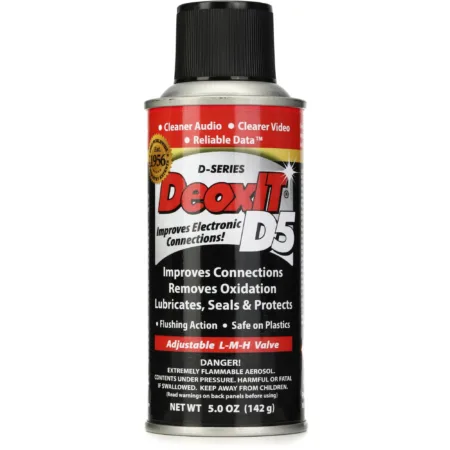
| DeoxIT D5S-6 | D-Series contact treatment, 5% spray | Metal contacts: switches, jacks, plugs, connectors | About 20% deoxidizing (D100L concentrate) | 5 oz aerosol, L-M-H valve; flammable |
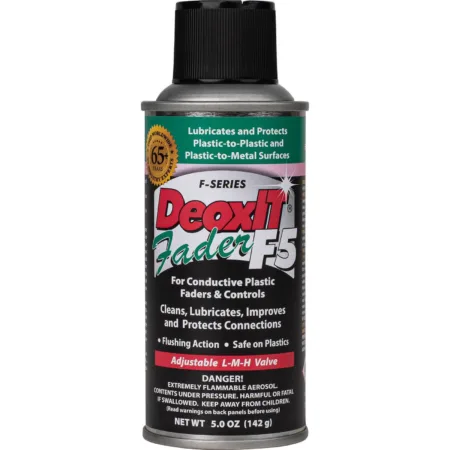
| DeoxIT F5S-H6 FaderLube | F-Series moving-contact lubricant, 5% spray | Conductive plastic faders, slide and rotary pots, carbon-based controls | Not a deoxidizer | 5 oz aerosol, L-M-H valve; flammable |
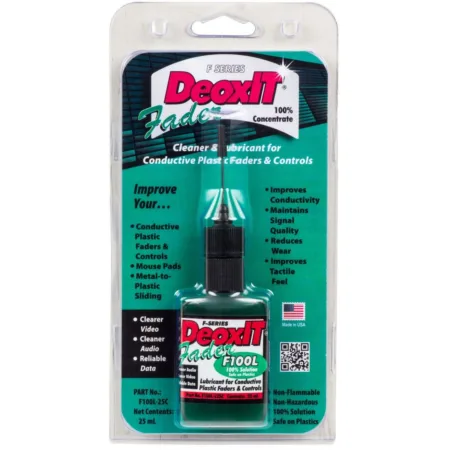
| DeoxIT F100L-L25C | 100% Fader F100L, no solvents | Same as F5, where you want precise drops and no overspray | Not a deoxidizer | 25 mL needle dispenser, about 1,250 drops; non-flammable |
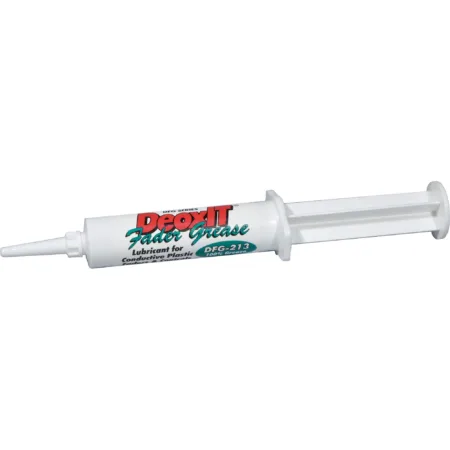
| DeoxIT FaderGrease DFG-213-8G | Damping grease (silicone grease and additives) | Faders and sliding controls that need more tactile feel | 0% | 8 g syringe; non-flammable |
Why the difference matters
A potentiometer or fader has two kinds of surfaces. The resistive track is usually carbon or conductive plastic, and a metal wiper slides along it; the solder lugs and any switch contacts are metal. Scratchiness can come from either side: dirt and worn lubrication on the track, or oxidation on metal contact points.
CAIG built the two series for those two surfaces. DeoxIT D-Series removes oxidation from metal: CAIG rates the D100L concentrate at about 20% deoxidizing action and recommends it for surfaces that have been in service or show visible oxidation. DeoxIT Fader F-Series is a precision lubricant for conductive plastics and carbon-based controls that replaces lubrication lost when a control is cleaned. CAIG’s data sheets state that Fader is not for metal contacts and connectors, and that DeoxIT D-Series, Gold or Shield should be used for those.
Which DeoxIT for guitar pots, amp knobs and mixer faders?
- Scratchy volume or tone pot (rotary): CAIG recommends its D-Series for most rotary pots: spray D5 (or the non-flammable DN5) into the pot, then work the knob through its full travel several times. F5 is CAIG’s pick for slide pots and faders.
- Crackling input jack, cable plug or selector switch: D5. These are metal-to-metal contacts.
- Noisy slide fader on a mixer or console: F5 to flush and lubricate. If the fader feels loose or too light afterward, a little FaderGrease restores the damped feel.
- Bench repair where overspray is a problem: F100L from the needle dispenser instead of the F5 spray.
How to clean a scratchy pot or fader with DeoxIT
These steps follow CAIG’s data sheet directions for the D5 and F5 sprays:
- Turn off and unplug the device.
- If metal parts in the control have been in service or show oxidation, pre-treat them with DeoxIT D5: one short burst, operate the control, wait a few seconds, one more short burst.
- Set the F5 valve, fit the extension straw and apply one short burst of DeoxIT Fader onto the plastic track through the opening in the control.
- Operate the control through its full range to spread the lubricant. Wait a few seconds and apply one more short burst.
- Wait two minutes before turning the equipment on.
- For extra lubrication or a heavier feel, apply a small amount of DeoxIT FaderGrease to the plastic surfaces.
To avoid overspray on nearby parts, spray onto a lint-free swab or cloth first and apply from that. CAIG also suggests treating one control, waiting a few days and then treating the rest if all is well. If a fader has dirt, grease or spilled drink residue, CAIG recommends F5 to flush out the contaminants before applying FaderGrease.
F5 vs F100L: spray or drops?
Both contain the same DeoxIT Fader F100L. The F5 spray is 5% F100L carried in 75% odorless mineral spirits with 20% propellant, so it flushes debris out as it goes in, and the solvent then evaporates. The F100L-L25C is the 100% liquid with no solvents, applied as about 1,250 drops of 0.02 mL each, with no flushing action. Choose F5 for a dirty control you can reach through an opening; choose F100L for a precise top-up on a clean, accessible track or where you cannot risk overspray. F100L is also non-flammable, while the F5 aerosol is extremely flammable until its solvent evaporates.
Plastic and rubber compatibility
CAIG describes the F-Series formulation as safe on plastics. With the solvent in the spray, CAIG rates ABS and polycarbonate fair to good and notes that rubber may swell until the solvent evaporates; on vintage equipment with aging ABS plastic, test first. The same cautions apply to the D5 spray. The solvent-free F100L and D100L liquids avoid the solvent issue entirely.
Temperature range and safety
CAIG rates the Fader F-Series from -15°F to 302°F (-26°C to 150°C) and the D-Series from -29°F to 400°F (-34°C to 200°C). The D5 and F5 aerosols are classified as extremely flammable aerosols; use them with the equipment off and unplugged, away from sparks and flames, in a ventilated area. Aerosols ship by ground to the contiguous US only. Read the SDS before use; ours are on the technical documents page.
Frequently asked questions
Can I use DeoxIT D5 on a potentiometer?
On its metal parts, yes. For the carbon or conductive plastic track, CAIG makes the Fader F-Series; D5 is designed for metal contacts.
Does DeoxIT F5 clean?
The spray flushes dirt and residue out with its solvent, but CAIG states the Fader formulation is not a deoxidizer. Oxidized metal parts need D5.
What is the difference between FaderGrease and FaderLube?
FaderLube (F5, F100L) is a light liquid lubricant; FaderGrease is a heavier damping grease used for extra lubrication and tactile feel on faders and sliding controls.
Which DeoxIT should I use on guitar pots?
CAIG recommends D5 (or DN5) for most rotary guitar pots, and D5 for jacks, switches and oxidized lugs. Save F5 for slide pots and faders.
Bottom line
Metal contacts get DeoxIT D5; conductive plastic and carbon tracks get DeoxIT F5 or F100L; FaderGrease adds feel. For most rotary pots CAIG recommends D5; for slide pots and faders, F5. Comparing D5 with D100L, DN5 and Gold? Read our DeoxIT D-Series guide; for the basics, see what DeoxIT is used for, or browse all DeoxIT products.
Products in this guide
-
DeoxIT
DeoxIT D5S-6 Contact Cleaner Spray with L-M-H Valve, 5 oz
Original price was: $20.99.$19.30Current price is: $19.30.In stock — ships in 1–3 days
- Ground ship only
-
DeoxIT
DeoxIT F5S-H6 FaderLube Spray, 5 oz
Original price was: $21.99.$20.99Current price is: $20.99.In stock — ships in 1–3 days
- Ground ship only
-
DeoxIT
DeoxIT F100L-L25C 100% FaderLube, 25 mL Needle Dispenser
$33.99Out of stock
- Dielectric
Sources
- CAIG Laboratories: DeoxIT Fader F5S-H6 product page
- CAIG Laboratories: DeoxIT Fader F-Series product information sheet
- CAIG Laboratories: DeoxIT Fader F100L-L25C product page
- CAIG Laboratories: DeoxIT FaderGrease DFG-213-8G product page
- CAIG Laboratories: DeoxIT D5S-6 product page
- CAIG Laboratories: DeoxIT Quick Specs (SB-D-ISCT-B, 5/2023)