
In Florida, keep butane canisters outdoors in all-day shade with airflow, never in a parked car, a garage or the house, and light a butane stove only outside, away from windows, even when a hurricane cuts the power. The heat limit, 120°F (49°C), comes from Gas One’s stove manual; the outdoor-only rule comes from CDC and ready.gov.
Storing butane in Florida heat
Gas One’s GS-3000 stove manual, which names the 8 oz GAS-1 as its fuel canister, says never to store butane near high heat, open flames, pilot lights or direct sunlight, or where temperatures exceed 120°F (49°C). It also says that at home the canister comes out of the stove and is stored outdoors in a well-ventilated area, out of children’s reach, and not in a building, garage or any other enclosed area. Check the warning printed on your can too.
- Not in a parked car or truck. The National Weather Service notes that a dark dashboard or seat in the sun can easily reach 180 to over 200°F, and that leaving the windows slightly open does not significantly slow the heating.
- Not in direct sun, such as a patio or pool deck that gets afternoon sun.
- Not in the garage or the house.
Choose a spot outside that stays shaded all day, has airflow, is away from grills and pilot lights, and is out of children’s reach. Keep cans upright, and retire any can that is dented, rusted at the seams or valve, or hisses when it is not connected. Ready.gov’s hurricane advice includes bringing in outside furniture before a storm; give the fuel the same thought and secure the cans where wind and rising water can’t carry them off, still outside the house and garage. The GAS-1 is non-refillable.
Cooking through a hurricane-season power outage
The Atlantic hurricane season runs from June 1 to November 30 and peaks around September 10, according to the National Hurricane Center. Ready.gov warns that after a hurricane you may be without supplies for days or even weeks, and that without power a refrigerator keeps food cold for about four hours and a full freezer for about 48 hours. A butane stove can bridge that gap if you follow these rules:
- Outdoors only. Ready.gov says generators, camp stoves and charcoal grills should always be used outdoors and at least 20 feet away from windows. CDC says camp stoves should never be used inside a home, basement, garage or camper, or outside near an open window or window air conditioner.
- Not during the storm. Shelter indoors while it passes and eat no-cook food; the Florida Department of Health’s kit list includes ready-to-eat food and a can opener. Gas One’s manual also says not to cook in windy conditions, because the flame can go out while gas keeps flowing.
- A stable, clear spot. Per the manual: a level, heat-resistant surface, 16 inches of clearance at the sides and 63 inches above to anything combustible, nothing overhead that could fall, a pan no wider than 10.5 inches, and the canister cover closed so the can does not overheat.
- Carbon monoxide alarms. CDC recommends battery-operated or battery back-up CO detectors near every sleeping area and lists headache, dizziness, weakness, upset stomach, vomiting, chest pain and confusion as the most common symptoms. If anyone has them, shut the stove off and get everyone into fresh air.
Gas One’s GS-3000 product page says “For Outdoor Use Only.” With another brand, follow its manual. Butane only struggles near freezing (see our butane vs propane comparison), rarely a concern in a Florida hurricane season. For the rest of your kit, use the Florida Division of Emergency Management’s hurricane supply checklist.
How many canisters should you keep?
Our guide to how long an 8 oz butane canister lasts calculates about 10,000 BTU of fuel per can: roughly 65 to 70 minutes at full flame on a 9,000 BTU stove such as the GS-3000, and a little over 2 hours at half flame. These are estimates from the energy in the fuel, not test results, and wind or an uncovered pot shortens them.
A worked example: two meals a day at about 20 minutes of full flame each, to boil water and heat canned food, is 40 minutes a day. Three days is 120 minutes, about 1.7 to 1.8 cans, so keep 2 plus a spare. The Florida Department of Health says an emergency kit should last at least seven days; a week at that pace is 280 minutes, about 4 to 4.3 cans, so keep 5 plus a spare.
| Daily cooking | Full-flame minutes a day | Cans for 3 days | Cans for 7 days | Pack for a week |
|---|---|---|---|---|
| Boil water twice (coffee, instant meals) | 20 | 2 | 4 | 4-pack |
| Two simple meals (example above) | 40 | 3 | 6 | 8-pack |
| Three cooked meals for a family | 90 | 6 | 11 | 12-pack |
Counts assume full flame on a 9,000 BTU stove, are rounded up and include one spare can. Half flame roughly doubles the time per can.
Choosing a pack
| Pack | Price | Per can | Good for |
|---|---|---|---|
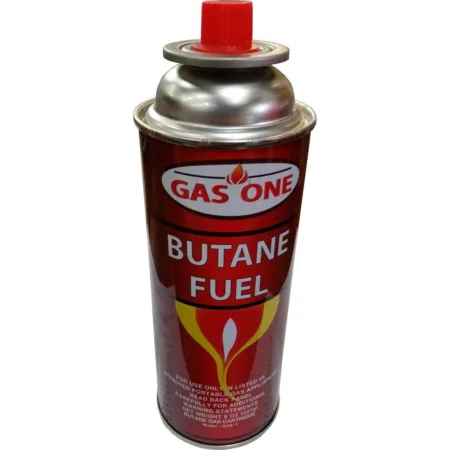
| Single can | $6.99 | $6.99 | Topping up a stove kit |
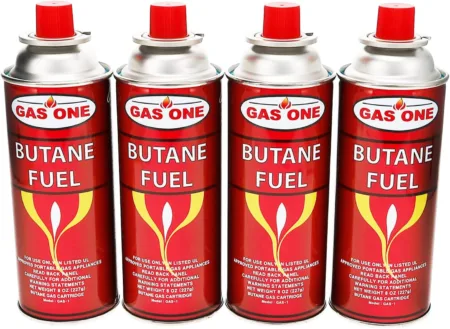
| 4-pack | $11.49 | $2.87 | Boiling water through a week-long outage |
| 8-pack | $16.99 | $2.12 | Two simple meals a day for a week |
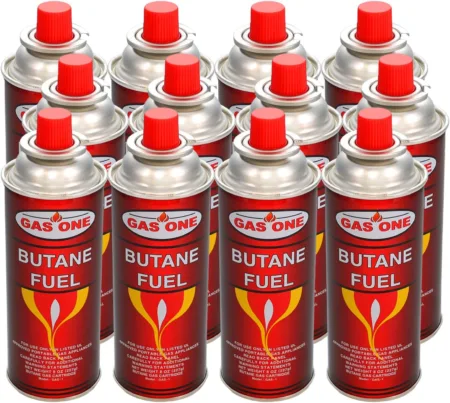
| 12-pack | $25.99 | $2.17 | A family cooking three meals a day |
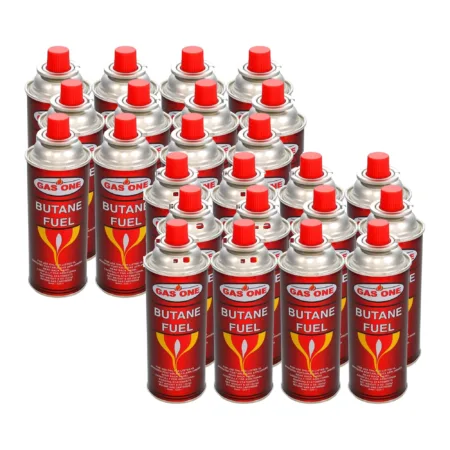
| 24-pack | $48.99 | $2.04 | Two households sharing, or food-service stock |
All five hold the same GAS-1 canister; see all GasOne butane canisters. For restaurants, Gas One’s manual cites a limit of 24 canisters of 10 oz or less stored in the restaurant, plus 24 more behind a 2-hour fire wall; confirm what applies with your local fire official.
Getting rid of empty canisters in Florida
Never put a used canister in a fire; Gas One warns that it can explode. Florida counties run their own household hazardous waste programs, and the county pages we checked name propane tanks rather than butane canisters, so call ahead:
- Miami-Dade County: two Home Chemical Collection Centers and periodic mobile drop-off events serve residents, and propane tanks are on the accepted list.
- Hillsborough County: collections run on select Saturdays at three sites for residents with a state-issued photo ID showing a Hillsborough address; propane tanks and aerosols are accepted.
- Polk County: the household hazardous waste facility accepts propane and other flammable gases, which the county warns can cause explosions or fires in the garbage.
Elsewhere, look up your county’s household hazardous waste program. These programs are for households; Miami-Dade and Hillsborough do not accept business waste, so restaurants need a private disposal company.
Delivery to Florida
We ship GasOne butane to Florida, New Jersey and New York only, by ground from our warehouse in Pennsauken, New Jersey. Orders are processed within 1–3 business days, and standard delivery usually takes 3–7 business days after shipment. Shipping to Florida is $5.99 per order under $35 and free on orders of $35 or more (merchandise subtotal before discounts), so a 24-pack ships free. Butane is a flammable gas, so there is no air or overnight service, and it can’t go to a P.O. box. Stock up early in the season rather than when a storm is already forecast. See our shipping policy, and for the rules up north, our NYC and New Jersey butane guide.
Frequently asked questions
Can I store butane canisters in my garage in Florida?
No. Gas One’s GS-3000 manual says to store canisters outdoors in a well-ventilated area, not in a building, garage or other enclosed area, and never in direct sun or above 120°F (49°C).
Can I use a butane stove inside during a hurricane power outage?
No. CDC says camp stoves should never be used inside a home, basement, garage or camper, and ready.gov says to use them outdoors at least 20 feet from windows.
How many butane canisters do I need for a hurricane kit?
For two meals a day at about 20 minutes of full flame each on a 9,000 BTU stove, plan on 3 cans for three days or 6 for a week, one spare included.
Can I leave butane canisters in a hot car?
No. The National Weather Service says a dark dashboard or seat in the sun can reach 180 to over 200°F, far above Gas One’s 120°F (49°C) storage limit.
How much is butane shipping to Florida?
$5.99 per order under $35 and free on orders of $35 or more, so the 24-pack ships free. Butane ships by ground only, and not to P.O. boxes.
Bottom line
Store butane outdoors in all-day shade, never in a car, garage or the house, and below 120°F (49°C). Cook only outside, at least 20 feet from windows, and only after the storm has passed. Count on 65 to 70 full-flame minutes per 8 oz can, keep a week’s supply plus a spare, and take empties to your county’s household hazardous waste program.
Products in this guide
-
Gas One
GasOne Butane Fuel Canisters, 8 oz (Pack of 12)
$25.99$2.17 / can
Out of stock
- Free ship NJ/NY
- Ships to NJ/NY/FL only
-
Gas One
GasOne Butane Fuel Canisters, 8 oz (Pack of 24)
$48.99$2.04 / can
Out of stock
- Free ship NJ/NY
- Ships to NJ/NY/FL only
-
Gas One
GasOne Butane Fuel Canisters, 8 oz (Pack of 4)
$11.49$2.87 / can
Out of stock
- Free ship NJ/NY
- Ships to NJ/NY/FL only
-
Gas One
GasOne Butane Fuel Canister, 8 oz
$6.99Out of stock
- Ships to NJ/NY/FL only
- Ground ship only
Sources
- Gas One GS-3000 instruction manual
- Gas One: GS-3000 portable butane stove
- National Hurricane Center: tropical cyclone climatology
- Ready.gov: power outages
- Ready.gov: hurricanes
- CDC: carbon monoxide poisoning basics
- CDC: carbon monoxide poisoning after disasters
- Florida Department of Health: emergency preparedness
- Florida Division of Emergency Management: hurricane supply checklist
- National Weather Service: children, pets and vehicles
- Miami-Dade County: Home Chemical Collection Centers
- Hillsborough County: household hazardous waste
- Polk County: household hazardous waste
- The Engineering ToolBox: fuel heating values